How Google AI Overviews Select and Rank Source Citations
Google's AI now cites sources outside top rankings using its own selection logic.

AI Overviews now appear across a large share of all Google searches, which makes citation inside them a primary visibility event rather than a secondary one. A user reads the generated answer, sees a handful of brand names and domains woven into it, and in most cases never scrolls past that answer to the blue links below it. That single fact reorganizes what search visibility means, and it demands a citation strategy built on its own logic rather than borrowed from the ranking playbook that governed the last two decades of SEO.
Why AI Overviews require a separate citation strategy from traditional SEO
The clearest break from conventional search behavior is this: a substantial share of AI Overview citations come from pages that do not rank in the top 5 organic results. A page sitting at position one can be left out of the generated answer entirely, while a page at position eight gets pulled into it, because the deciding factor is how cleanly that page's content extracts into a passage, not where it lands on the results page. That alone should unsettle anyone still treating organic rank as a proxy for AI visibility.
Roughly 83% of searches that trigger an AI Overview end without a single click to an external website. Most of the traffic that used to flow from a ranking position now flows nowhere. What remains valuable is the citation itself, the brand name and domain appearing inside the answer, which has become the visibility outcome on its own terms, independent of whether it drives a click. A business can be mentioned by name to a majority of the people researching its category and never see one of them land on its site.
That doesn't mean citation is worthless without the click. Sites that get cited consistently in AI Overviews see measurably higher direct traffic and branded search volume in the weeks that follow. People remember the name even when they don't click the link, and they come back to it later by typing it directly into the search bar or going straight to the domain. That lag effect is a form of SEO value that conventional rank trackers were never built to capture. A site can be winning in a way that monthly rank reports simply don't show. Given both the structural indifference to top-5 rank and the delayed brand payoff, the only reasonable conclusion is that citation inside AI Overviews runs on a separate set of rules, and anyone treating it as a side effect of good rankings is measuring the wrong thing.
The five-stage pipeline that turns 500 candidate pages into 5–15 citations
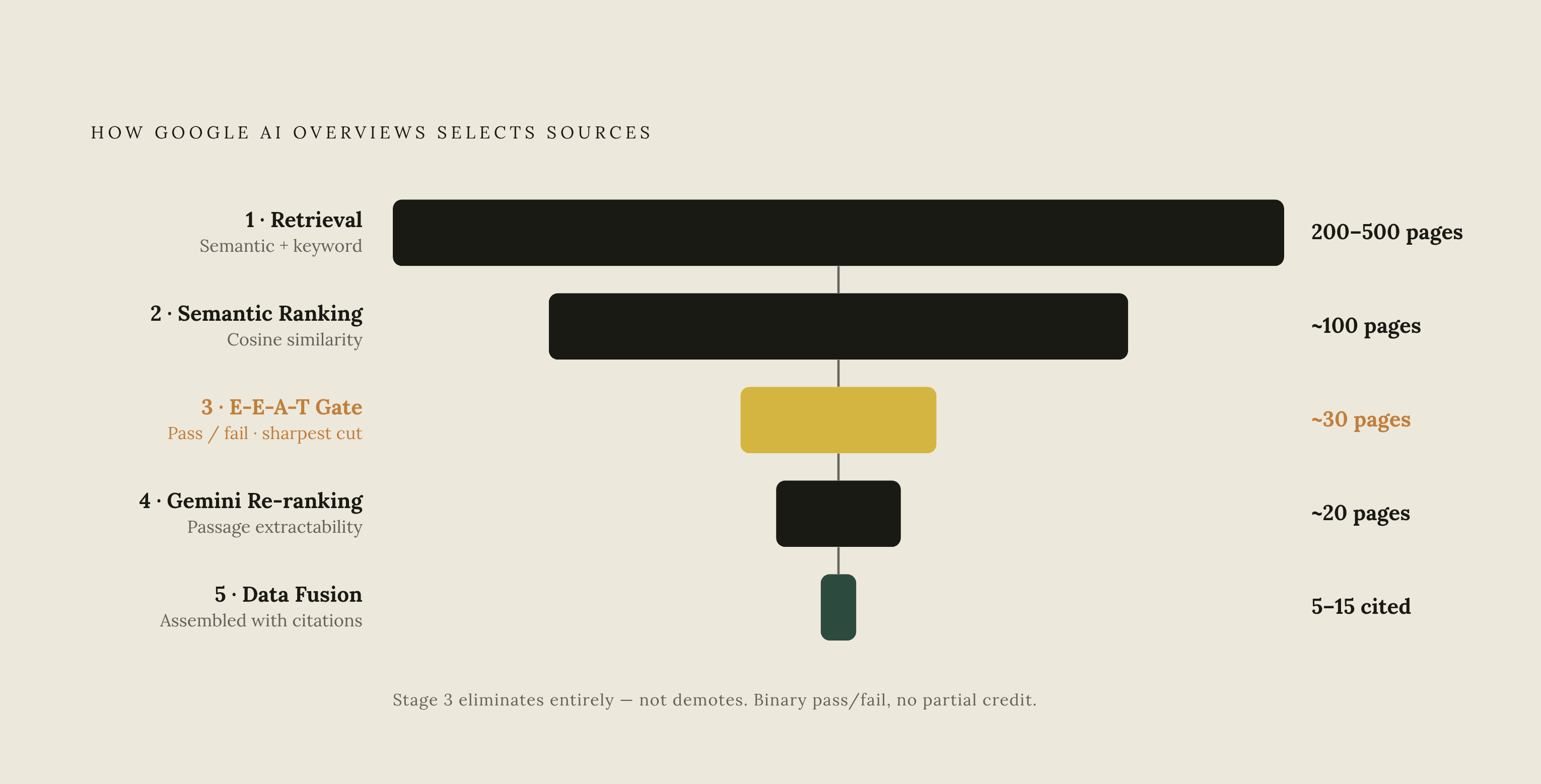
Those separate rules are the output of a defined mechanical process, and understanding that process is the only way to act on it with any precision. Google AI Overviews select sources through a multi-stage filtering pipeline that narrows an initial pool of 200 to 500 candidate documents down to the 5 to 15 sources that end up cited. The system runs on the Gemini family of large language models, grounded in live web results through a technique Google itself calls "grounding," built on Retrieval-Augmented Generation. Instead of answering purely from what the model learned in training, it pulls in real passages from indexed pages at the moment of the query and builds its answer around them.
The first stage is retrieval. Semantic embeddings and keyword matching filter the open web down to a few hundred candidate pages, and anything non-indexed or only loosely related to the query gets removed before any deeper evaluation starts. This stage still looks a great deal like conventional SEO: topical relevance, backlink authority, and overall content quality decide whether a page even enters the candidate pool. A page that can't clear this bar never gets a chance to compete in the stages that follow, so none of the later-stage signals matter if a site hasn't done the foundational work first.
Stage two is semantic ranking. The system measures cosine similarity between each candidate page and the query's embedding, narrowing the pool further and dropping content that sits in the same general topic but doesn't answer the specific question being asked.
Stage three is the E-E-A-T filter, and it behaves differently from everything before it. Rather than scoring a page along a continuum, it operates as a binary pass or fail gate: content that doesn't clear the authority and trust threshold gets eliminated outright, no matter how strongly it performed in the semantic ranking stage. This is the point where the pipeline parts ways most sharply with traditional ranking logic. A page carrying a high domain authority score that fails this gate doesn't get docked a few positions, it gets dropped from consideration entirely.
Stage four hands the surviving candidates to the Gemini model itself for re-ranking. Here the evaluation shifts to passage-level extractability and whether a given chunk of content actually answers the question completely; a page can be authoritative and still get filtered out at this stage if its content is structured in a way the model can't cleanly pull from.
The fifth and final stage is data fusion, where the surviving 5 to 15 sources get assembled into the coherent summary the user actually reads, complete with inline citations. Not every page that contributed gets a visible citation. Some sources inform the synthesis in the background without ever appearing as a named citation in the final output.
The query fan-out mechanism runs underneath all five stages, and it shapes which pages advance at every step along the way. When someone submits a query, Google's system breaks it apart into multiple sub-queries and evaluates many pages against each one simultaneously, so pages matching the intent behind any one of those sub-questions can advance independently of how they perform against the original query as typed. A page can earn its citation through a sub-query it was never deliberately optimized for. Topical breadth across a subject's full fan-out matters as much as precision on the head term.
Which signals decide citation at each stage of the pipeline
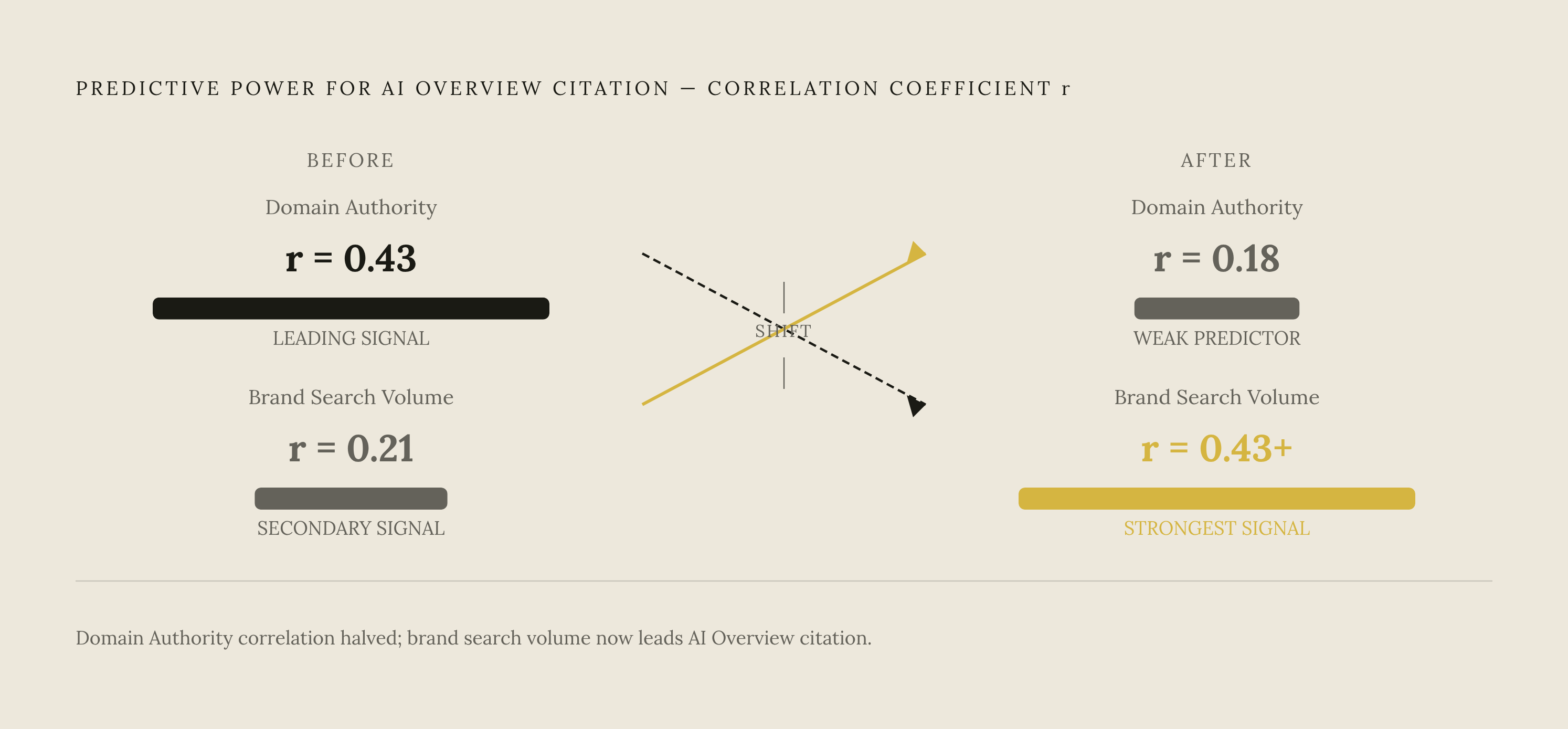
The signals that determine AIO citation cluster into three categories: entity authority, content extractability, and topical differentiation. What ties these categories together is a clear shift away from domain-level authority as the dominant factor. The correlation between traditional domain authority metrics and AI citation has weakened sharply, with Domain Authority's correlation coefficient dropping from r=0.43 to r=0.18, making it a weak predictor at best. In its place, brand search volume, not backlink count, now shows the strongest correlation with AI citations. The pipeline is rewarding recognizability and demonstrated expertise over the accumulated link equity that used to define authority.
That shift becomes concrete at the E-E-A-T gate in stage three, which checks for four specific signals: author attribution carrying verifiable credentials, editorial transparency about how the content was produced, domain reputation built through citation by other authoritative sources, and topical consistency, a demonstrable track record of covering the subject area rather than a one-off post. Because this gate is binary, content that does not clear the authority and trust threshold is eliminated entirely, regardless of how well it ranked in Stage 2.
At stage four, passage-level extractability is governed by how the content is structured. Self-contained answer units running 134 to 167 words line up with the passage lengths Gemini extracts most reliably. Where that passage sits on the page matters too: a CXL analysis of AI Overview citations found that 55% of cited passages came from the first 30% of the page, meaning front-loaded answers have a real structural advantage over content that buries its conclusion. Structural markup carries measurable weight as well. In the same dataset, pages marked up with Article and BreadcrumbList schema were cited more than twice as often as otherwise comparable pages without that structured markup, which suggests the model leans on explicit structure to extract a clean passage rather than inferring it from unstructured prose alone.
Entity density functions as an accelerant at both stage two and stage four. Pages carrying 15 or more recognized Knowledge Graph entities show a substantially higher probability of selection, because that density signals to Gemini that the page is genuinely grounded in the subject rather than merely adjacent to it. Multimodal content adds another layer of advantage at stage four: pages that combine text with original images, video, or tables are substantially more likely to be selected as a source than text-only pages covering the same ground.
Topical authority across the full fan-out closes the loop with stage two's query-breaking logic. A Surfer study covering thousands of keywords found that pages ranking across a topic's fan-out queries, not just its main keyword, are substantially more likely to be cited. Covering the entire semantic neighborhood around a subject has become a direct citation strategy in its own right. Across every one of these signals, the pattern holds: the deciding factors have moved to the page and passage level, replacing the domain-level authority metrics that used to carry the most weight in conventional ranking.
How far AIO citation has decoupled from traditional organic rankings (and why the figures conflict)
That argument runs into a genuinely contested number, and the honest response is to lay out the conflict rather than paper over it. One widely cited figure holds that Google AI Overviews maintain a 93.67% correlation with top 10 organic results, the strongest tie to traditional search rankings found among any AI platform studied. Set that next to the earlier claim that a substantial share of citations come from outside the top 5, and the two findings look like they can't both be true.
They can, because they are measuring different things. One line of research asks whether cited pages rank exclusively within the top 10, while the other asks whether cited pages appear anywhere within the top 10 at all, and those are two separate questions that can both hold simultaneously. Methodological choices, how each study defines its window, what it counts as a match, which sample of queries it pulls from, drive these diverging conclusions as much as any underlying shift in how Google's system behaves. Anyone citing one figure without acknowledging the other is likely reaching for whichever number supports a position they already held.
What the available data does agree on is more useful than either contested percentage. AIO now cites pages from positions 11 through 100, and pages ranking beyond position 100, at close to equal rates. The tail of the index, the pages that conventional SEO treats as functionally invisible, is a live citation surface rather than dead inventory. Traditional ranking still matters as a gatekeeper. It gets a page into the candidate pool at stage one of the pipeline. But it no longer guarantees citation once the synthesis layer takes over, because that layer applies its own extraction and authority criteria independently of where the page sat in the organic results.
The decoupling extends further than organic search alone. Google AI Overviews and Google AI Mode share only a small fraction of cited URLs for identical queries, so a brand earning a citation in AI Mode has no guarantee of being cited in AIO for the same search, and the reverse holds just as true. Whatever the precise overlap figure between AIO and the top 10 turns out to be once the methodological dust settles, the practical conclusion stands either way: optimizing purely for organic rank is an incomplete strategy for a search landscape where citation is decided by a separate, independently operating layer.
Which domains dominate AIO citation
Looking at which domains actually show up across AIO citations turns the abstract pipeline into something concrete, and the pattern is not random. Citation is concentrated in a strikingly small set of domains, and what populates that set says as much about how the pipeline behaves as any single signal does on its own.
Wikipedia sits among the top two sources across every study of AIO citation, functioning less like a competitor fighting for position and more like a reference scaffold that gets cross-cited alongside Google's own Knowledge Graph. Its dominance isn't really a story about winning a competitive battle for citation; it reflects the structural role broad reference content plays in grounding an AI-generated answer before the system layers in more specific sources.
Reddit accounts for a notable share of AIOs, Heroic Rankings found, and Google has moved beyond passive tolerance of that presence by formally introducing a "Community Perspectives" section that surfaces direct quotes from Reddit. User-generated content has been built into the citation system as its own recognized category rather than treated as a lesser source that occasionally slips through the gate.
Government sources round out the picture at the opposite end of the authority spectrum from forum content, cited at a rate far higher than the average website. Put the three together, the reference scaffold of Wikipedia, the newly institutionalized voice of Reddit's community perspectives, and the outsized trust extended to government domains, and a clear picture of the pipeline's priorities emerges: structural, not competitive, authority anchors the system. It rewards structural authority, demonstrated firsthand community experience, and institutional trust, in roughly that order of frequency, over the accumulated backlink profiles that defined authority in the search era this pipeline is already leaving behind.
Sources
- Google AI Overviews Citation Source Index 2026
- Google AI Overviews Ranking Factors: 2026 Guide to Winning Citations
- How Google AI Overviews Choose Sources: 2026 Citation Guide
- AI Overview Citation Analysis: How Google Selects Sources in 2026
- Google AI Overviews Source Selection: Reverse-Engineering How AIO Picks Sources