How Original Research and Proprietary Data Earn AI Citations
Original data and exclusive findings beat domain authority in AI citations.

A brand publishes a well-researched article. A competitor publishes a near-identical piece a month later, same claims, different words. An AI engine fielding a question on that topic can cite either one, or neither, because nothing distinguishes them. That interchangeability, not writing quality, is the real decision point in AI search: a page earns citation through exclusivity, not polish.
Why AI engines must cite exclusive data
AI search engines answer questions through retrieval-augmented generation. The system retrieves a set of candidate pages on the topic, builds a synthesized answer from them, and attaches specific facts to specific sources, as Similarweb's analysis of the generative engine optimization (GEO) moat describes. When ten pages all repeat the same generic observation, the model has ten interchangeable options for sourcing that claim. It can cite any one of them or simply drop the attribution and state the point as general knowledge. When only one page holds a specific number, that page becomes the only possible source for that fact. The model has no substitute to reach for.
This changes the competitive logic of visibility. Traditional search ranking runs on domain authority and backlink profiles, where an established domain tends to outrank a newer one regardless of what either page actually says. AI citation does not work that way: a small domain with one proprietary data point can out-cite a high-authority domain whose content, however well written, says nothing that cannot be found elsewhere. Authority still matters for plenty of purposes, but it no longer guarantees citation the way it once guaranteed rank.
The data on this reversal is specific. The GEO study from Princeton and Georgia Tech, published at KDD 2024 (Aggarwal et al.), found that adding statistics to a page improved its AI visibility by 41%, and that pages which ranked fifth in traditional search saw a dramatic visibility improvement once original statistics were added, while pages that already ranked first actually lost ground. That finding inverts the assumption many marketers still carry from a decade of SEO practice: ranking well in Google no longer predicts citation in an AI-generated answer, and in this dataset it sometimes predicted the opposite.
None of this should be oversold. A critical review of GEO research published in July 2026 (arXiv:2607.14035) examined these techniques for a stable, longitudinal, cross-platform causal effect on organic discoverability and found none. Retrieval and citation are structurally separate events, and no single tactic, including exclusive data, forces an AI engine to cite anything. Exclusivity raises the probability that a page gets cited. It does not guarantee the outcome, and the honest version of this argument treats it as a probability shift, not a lock. The remainder of this piece is concerned with what controls that probability once exclusivity is in place.
How citation rates differ by content type
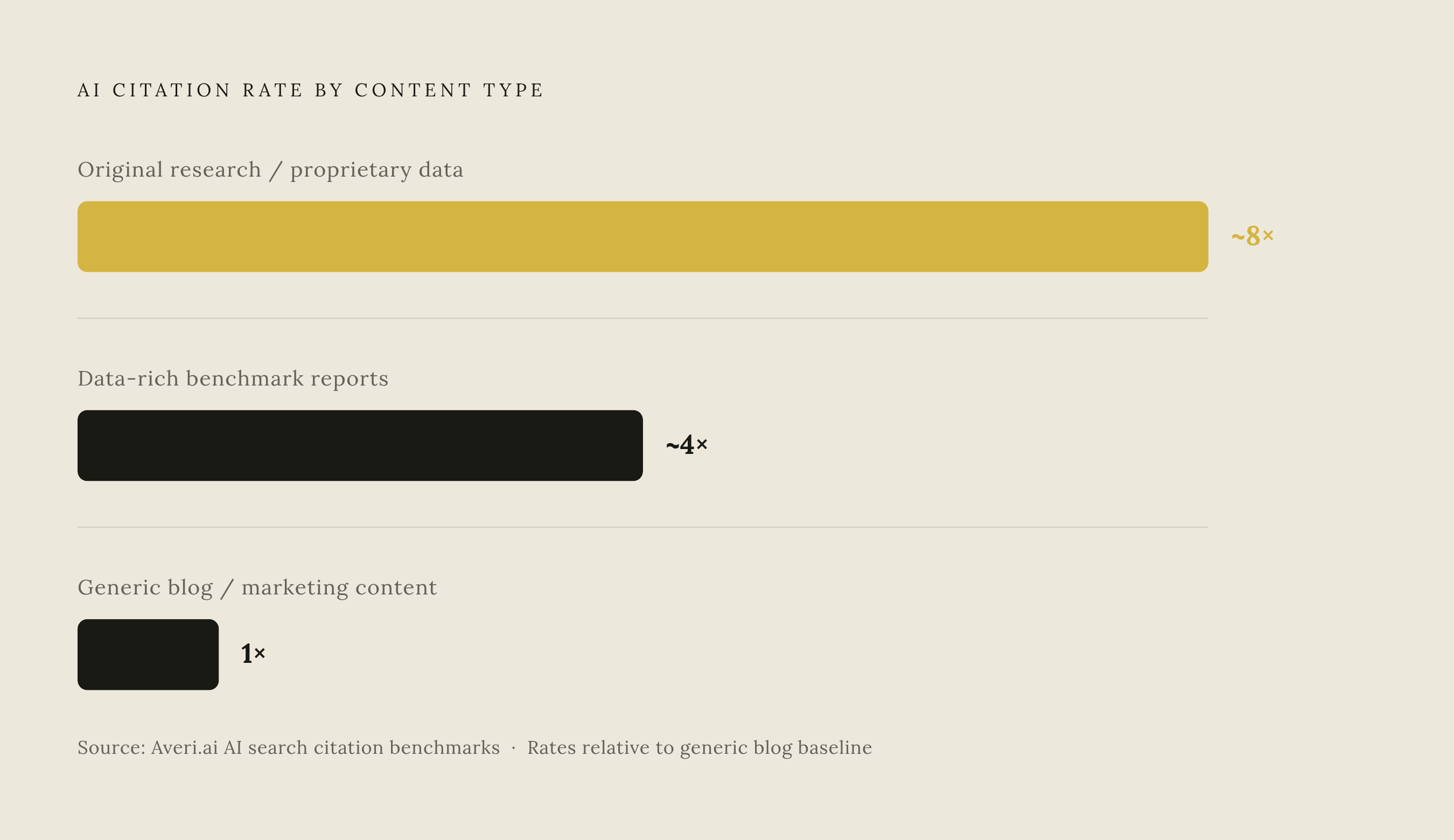
The gap between content types is large enough to change how a content budget should be allocated, beyond how a single article should be written. Original research and proprietary data earn AI citations at a rate many times higher than standard blog posts, and the difference becomes even starker against product and marketing pages: Averi.ai's AI search citation benchmarks show the gap. That advantage is large, well beyond what slightly better writing or a slightly more authoritative domain would produce. It is the kind of gap that should reorder where a content team puts its effort, because a single well-built study appears to outperform a much larger volume of conventional posts.
Benchmark reports built on real data occupy a middle tier: they outperform standard blog content by a wide margin, though they still sit behind fully original, owned research in citation rate. The hierarchy that emerges is not complicated. Proprietary findings sit at the top, data-rich benchmarks follow, and generic content, however competently produced, sits well below both.
This matters more given how much of the citation landscape is already claimed by sources outside a brand's own domain. Meltwater's analysis of millions of citations found that earned and news media account for a large share of all citations across large language models, and that ChatGPT in particular gives earned media the majority of its citations. Owned content, in other words, is already competing uphill against third-party press coverage for a model's attention. Original research is the category that lets owned content compete on that uneven field, because earned media, however credible, cannot supply a proprietary number that only exists on one domain. A press outlet can report a finding. It cannot originate one that belongs to somebody else's dataset.
The three content attributes that make a piece citable
Three attributes recur across the content that AI engines actually select to cite: original data unavailable anywhere else, expertise credentials tied to a specific, named individual, and a complete answer to a precise question contained within a single piece. Andy Crestodina's AEO research at Orbit Media identifies these three as the documented structure of citable content in 2026. Any piece of content can be measured against this list directly: does it contain a fact no other page has, is it attributed to someone whose expertise can be verified, and does it resolve the question a reader is asking without deferring to another page for the actual answer.
Original data carries the most weight of the three, and it is the attribute this piece is most concerned with developing. An AI system synthesizing an answer needs a source that contributes something it cannot already retrieve from ten other pages on the same subject. A specific survey result, a documented case outcome, or a proprietary benchmark gives the model something to cite that has no substitute.
Credentials function as a verification check on the author rather than the data itself. An attribution naming "Andy Crestodina, who has published annual blogger surveys since 2014 and personally analyzed content performance for more than a thousand clients" gives a model something concrete to evaluate, compared with a byline crediting an unnamed team. The model checks whether the claimed expertise is the kind that can be verified against a track record, not whether the author carries an impressive title.
The third attribute, completeness, is structural rather than reputational. Content that gestures toward an answer and sends the reader elsewhere to finish the thought is not something a model can lift and cite as a standalone fact. A related signal from an analysis of more than 21,000 citations by Zhang, He, and Yao found that high-influence pages tend to run longer, carry clearer structure, align closely with the semantics of the query, and hold a denser concentration of extractable evidence, meaning definitions, numerical facts, comparisons, and procedural steps. Tone matters here too. Semrush's 2025 research found that promotional copy correlates negatively with citation. Research published on a brand's own domain has to read like evidence rather than marketing copy if it wants to be treated as a source rather than an advertisement.
Three practical routes to producing proprietary data
Producing qualifying original data does not require a dedicated research division or a large study budget. Three routes are available to most organizations, and the right one depends on what data an organization already holds rather than which route ranks highest in theory.
The first route mines data an organization already has sitting in its own systems. Position Digital demonstrated this by analyzing Google Analytics data across its SaaS clients to identify which marketing channels actually drove traffic, engagement, and conversions, a dataset no competitor could access or replicate. The resulting report secured a citation in ChatGPT within one day of publication. Sales platforms, email tools, CRM systems, and analytics dashboards all hold patterns that nobody outside the organization can see. Anonymized and aggregated properly, those patterns become a benchmark that only that organization is positioned to publish. Start by identifying a question an audience keeps asking, then work backward into whatever internal system already contains the answer. A specific client outcome, something like a documented reduction in onboarding time tied to a particular process, qualifies as original data in its own right.
The second route surveys a defined audience directly. Resource Guru's Agency Overworking Report, produced with Position Digital, surveyed agency professionals on workload, burnout, and workplace conditions, and the resulting data generated dozens of backlinks, coverage in Forbes, and multiple citations across large language models. A separate case in B2B SaaS followed a similar path: a team surveyed marketing professionals directly, published its findings alongside full methodology, and earned citations in TechCrunch, Marketing Week, and Search Engine Journal, which in turn drove a dramatic increase in referral traffic from AI platforms. The design choices behind a survey determine how citable its output becomes. Respondents should be defined precisely by role, industry, and company size. Questions should favor quantitative formats, rating scales and numerical ranges, over open-ended responses that are harder for a model to extract cleanly. Methodology should be published alongside the findings rather than held back.
The third route takes existing public data and subjects it to original analysis that produces a conclusion the source data does not state on its own. HR DataHub analyzed millions of UK job advertisements together with survey data to build a pay transparency report showing differences across industries, employers, and seniority levels, turning publicly available postings into a primary source through the analysis layered on top of them, and the report secured a citation in an AI Overview for its target keyword. The analytical work is where the value in this route sits, beyond the act of gathering the sources. Combining multiple datasets, isolating a pattern, and stating a conclusion none of the underlying sources state individually is what makes the output original. Job postings, earnings reports, government open data, app store reviews, patent filings, and academic studies that have not yet been synthesized for a practitioner audience all qualify as raw material for this route.
None of these three routes produces a citation on its own. Citation selection favors packaging that lets an AI engine find, parse, and attribute what the research produced: original data that cannot be sourced elsewhere, specific expertise credentials tied to a named author, and a complete standalone answer to a precise question.
Packaging data for AI extraction and attribution
A data-rich page that an AI engine cannot parse correctly might as well not exist for citation purposes. A model can extract a finding and attribute it accurately only when the page's structure supports that, and original data buried inside dense prose or formatted ambiguously is cited less often than the same finding presented in a format built for extraction.
Structure for extractability. LLM Pulse's citation guidance holds that clear heading hierarchies, a bottom-line-up-front organization, and sections that stand on their own all improve how reliably an AI engine parses a page. The headline finding belongs near the top of the page: studies of ChatGPT's citation behavior found citations concentrated heavily in the first portion of a page, so a number buried in a methodology appendix several screens down loses much of its citation probability before a model ever reaches it. Sections should be self-contained because AI engines extract individual passages rather than entire documents, so each section needs to state its finding completely rather than depending on a reader, or a model, having absorbed an earlier section first.
Make claims specific and verifiable. Position Digital's guide draws the contrast: a specific, verifiable statistic naming how many US adults use AI to search for information gives a model something concrete to attribute to a source, while a sentence like "AI is becoming more popular among American adults" is a general observation a model can paraphrase without crediting anyone. Every statistic should carry a named source, a date, and a clearly defined population, because that is the format AI citation engines are built to pull from and attribute correctly.
Publish methodology transparently. Credibility and verifiability function as a primary selection criterion. When methodology sits alongside the findings, an AI system has a stronger basis for treating the data as reliable and attributable, as Position Digital's guide explains. A visible methodology section also separates genuine research from content that mimics the format of research without the underlying data behind it, a distinction that matters more as a growing share of references circulating through ChatGPT are themselves predicted to be AI-generated, a trend that threatens to erode the advantage original data currently holds if synthetic benchmark content becomes difficult to tell apart from human-produced research.
Add expert attribution. Averi.ai's benchmarks show that adding expert quotes tied to real credentials produces a measurable improvement in citation rate. A byline needs to establish expertise that can actually be checked, through a named role, a specific number of years in the field, or a documented track record, rather than a name alone.
Treat freshness as a structural requirement. LLM Pulse's citation analysis found that pages left unrefreshed on a quarterly basis are three times more likely to lose citations over time, particularly on topics that move quickly. Original research functions as a competitive moat only for as long as it remains the most current primary source available on its subject. A refresh schedule belongs in the research plan from the date of publication, before citations start to fade.
None of these practices forces a citation. They raise the odds that a model parses a page correctly and attributes it accurately once the underlying data has already earned a place at the table.
What happens after publication
Publishing a proprietary finding is not a single event with a single payoff. Once a finding is published and picked up elsewhere, the citation cycle becomes self-reinforcing: each secondary reference deposits the original data onto another trusted domain, and each additional domain increases the odds that an AI engine encounters the finding and cites it somewhere in its index.
Similarweb's own experience with its research illustrates the mechanism directly. Its "Downstream Impact of AI Visibility" report was published carrying proprietary numbers, then summarized by SEO consultant Aleyda Solís on X, quoted separately by performance marketer Stephen Davis, and subsequently covered by Social Media Today and Search Engine Land. Each of those downstream mentions placed the same original numbers on a different domain with its own authority and its own audience, multiplying the number of places an AI engine could encounter the finding and trace it back to its source. The original report did not just earn one citation and stop. It seeded a chain of secondary references that kept depositing the same proprietary data across the web long after the report's publication date, each new deposit adding another point of contact between the finding and whichever model happens to be searching for it.
Sources
- Original Data as a GEO Moat
- How to Earn AI Citations With Data-Driven Content
- Content That Earns AI Citations in 2026 Has Three Specific Characteristics
- AI Citations: what they are, sources, and how to earn them
- Earned vs. Owned AI Citation Rates: Which Content Gets ...
- ChatGPT Citation Sources: What Gets Cited in 2026
- RAG Collapse: LLM Responses Collapse When Retrieved Documents Are Self-Authored