Zero-Click Search Rates by Industry Vertical
Zero-click rates vary dramatically by device, surface, and industry vertical.

Roughly two-thirds of searches end without a click. That figure appears in strategy decks, board slides, and agency pitches as though it were a settled fact about how Google works, but the number falls apart under any real scrutiny because the rate shifts sharply depending on which surface handled the query, what device the user held, what kind of question they were asking, and what industry the query touched. A single top-line figure flattens all of that variation into something that sounds authoritative and tells a marketer almost nothing about what to do on Monday morning.
SparkToro's study, built on the Datos panel, is the most commonly cited anchor for this conversation: it found that 58.5% of U.S. Google searches and 59.7% of EU searches ended without a click. That study predates the current scale of AI Overviews, so the number functions as a baseline rather than a description of where things stand today. A more recent figure, also circulated by SparkToro, puts the majority of U.S. Google browser searches between January and April 2026 as ending without a click, but this later number comes from Similarweb data rather than the Datos or Semrush panels the 2024 study drew on, and it weights devices differently. Lining these two figures up side by side and calling the difference a trend misreads what each study actually measured. They are two separate snapshots, taken with two separate instruments, and treating the gap between them as a clean year-over-year change manufactures a precision neither study was built to support.
The deeper problem sits in what "zero-click" is even counting. A search that ends without a click could mean the user found a satisfying answer directly in the search results and moved on happy. It could mean the user rewrote the query and tried again because the first attempt failed. It could also mean the user left frustrated, having gotten nothing useful. A user who looks up a business's phone number and calls it produces a zero-click search and a completed business outcome at the same time, which is the opposite of a loss. These are not interchangeable events, and lumping them into one rate erases the distinction that actually matters to a business trying to figure out whether its search strategy is working. The behavior itself, a search that ends without a click, does not tell you the user's motivation or satisfaction, and a single website's click-through rate is not a stand-in for the zero-click rate of the web as a whole. Anyone building strategy on the two-thirds headline is building on a number that was never meant to carry that kind of weight.
Device type and AI surface compounding before industry
Before an industry-level comparison means anything, two variables upstream of industry already decide whether a given search lands in a low-containment environment or one approaching near-total containment: the device the search happens on, and which Google surface answers the query. Skipping past these two factors and jumping straight to "what's the zero-click rate in my industry" produces a number that is already contaminated by device mix and surface mix before the industry variable even enters the picture.
Mobile searches show substantially higher zero-click rates than desktop searches. That gap carries real weight because the industries that skew mobile and the industries that skew desktop are not randomly distributed. People search while they stand in a store or scroll on a couch, so these categories lean heavily toward mobile devices. B2B categories and other desktop-oriented fields, where someone is doing structured research at a workstation, lean the other way. That means part of what looks like an industry effect in a cross-industry comparison is actually a device effect wearing an industry's clothing. A vertical with a high zero-click rate might just have an audience that happens to search on phones, not one where Google has especially mastered intercepting the user's intent.
Surface matters just as much, and the two AI surfaces Google has built into search need to be treated as distinct rather than folded into one undifferentiated "AI is eating my clicks" narrative. One surface sits inside the traditional results page and answers a query without the user leaving Google. The other operates as a separate, more conversational mode of search. Each one behaves differently, triggers on different query types, and interacts differently with the kind of content that can still earn a citation or a click. Treating them as a single phenomenon erases the distinctions that determine which content strategies still function in each environment.
Put the two variables together: a healthcare marketer whose audience searches primarily on mobile phones, and a B2B software marketer whose audience searches primarily from a desktop at work, are operating in fundamentally different zero-click environments before anyone has said a word about healthcare or software as industries. Device and surface form the first two layers of a three-layer system. Industry vertical is the third layer, and most businesses jump to it first, skipping the groundwork that explains why their numbers look the way they do.
The vertical zero-click spectrum: from near-total containment to resilient transactional categories
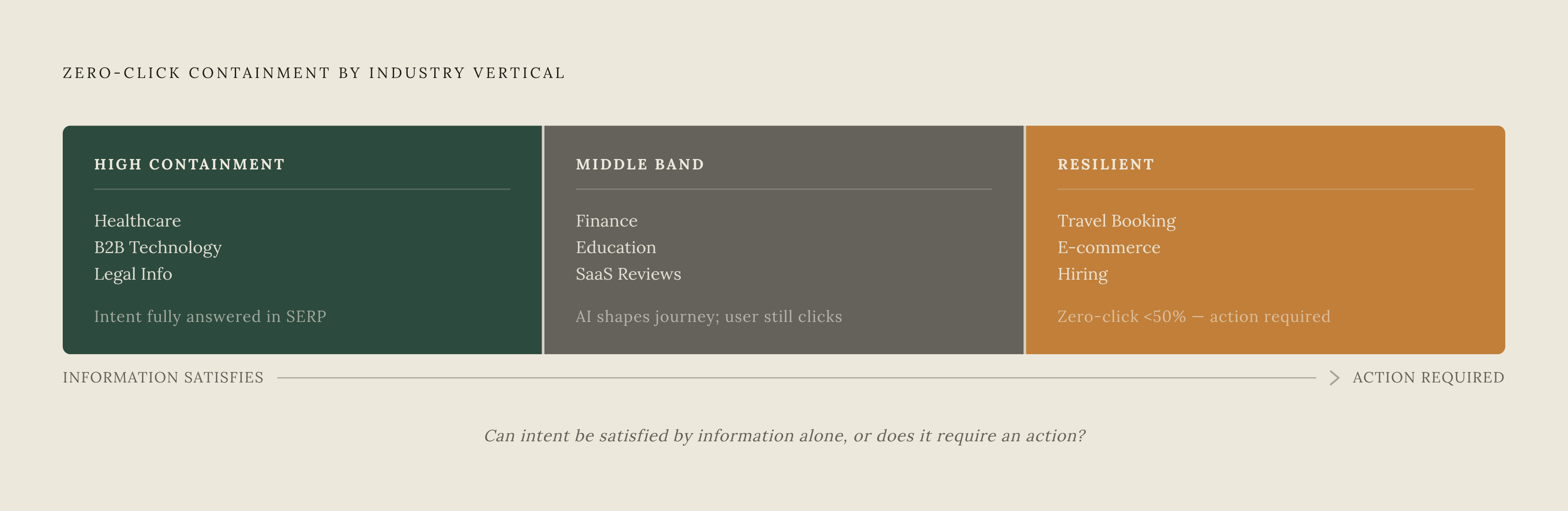
Once device and surface are accounted for, the industry-level picture becomes the sharpest and most useful part of this entire conversation, because the spread between verticals is wide enough that two companies, both investing seriously in SEO, can be playing entirely different games depending on which industry they're in. At one end of the spectrum, Google resolves nearly every query in a vertical and sends the user nowhere else. At the other end sit verticals where a click remains structurally necessary because the thing the user actually wants, a purchase, a reservation, a signed contract, cannot happen inside a search results page no matter how good the AI-generated summary is.
Healthcare and B2B technology categories are at the high-containment end of this spectrum, where AI Overviews and related features routinely answer the user's question directly and completely, so there's little reason left to click through to a publisher's site. These are categories built around information-seeking behavior: symptoms, definitions, comparisons, explanations. When the entire value of the search is the information itself, and that information can be summarized accurately in a few sentences at the top of the results page, the click becomes optional.
A middle band of verticals sits in a different position, where AI Overviews shape the user's journey but don't fully contain it. In these categories, the AI-generated answer gives the user a starting point, a framework, a shortlist, but the user still has reason to click through to compare options, read reviews, or get details the summary didn't cover. The zero-click rate here is real but moderate, and the click retains commercial value even where it's no longer guaranteed.
At the resilient end of the spectrum, transactional categories keep zero-click rates below half, because the user's core intent cannot be satisfied by a summary. Booking a flight, buying a product, hiring a contractor, signing up for a service: these actions require leaving the search results page by definition. No matter how sophisticated the AI Overview becomes, it cannot complete a checkout flow or take a payment, so a click stays structurally required.
What determines which band a vertical falls into is not the vertical's size or sophistication, but a simpler underlying question: can the user's core intent be satisfied by information alone, or does it require an action? Healthcare and B2B technology searches skew heavily toward information-seeking, where an accurate summary genuinely finishes the job. Transactional categories skew toward action, where no summary, however well-written, can substitute for the thing the user actually came to do. That single distinction, information versus action, explains more about where a vertical sits on the zero-click spectrum than any other factor in this analysis, and it's the logic that carries directly into the next layer of the problem: query intent.
Query intent as a second dimension of risk across vertical boundaries
Industry vertical sets the starting position on the zero-click spectrum, but it doesn't explain the wide variance that occurs inside a single industry, because query intent cuts across vertical boundaries and adds a second dimension to the risk. A healthcare publisher fielding an informational query about a condition's symptoms faces a very different zero-click exposure than it does when fielding a commercial-investigative query that compares treatment providers. A legal services firm sees the same split: a query about what a term means behaves nothing like a query comparing firms before hiring one. Most verticals contain a mix of both intent types, so a strategy built at the vertical level alone misses the variable that actually predicts outcomes at the query level.
The most consequential shift in this part of the picture involves commercial investigation queries, the searches people run when they've moved past general curiosity and started comparing specific vendors or products before buying. These queries crossed above the halfway mark for zero-click, a roughly 9-point increase, so this is the most concerning trend line in the entire dataset for brands that depend on organic search to drive revenue. Commercial investigation occupies the consideration and vendor-selection stage of the purchase journey, the exact point where a brand wants to be the click a prospective customer makes rather than a name mentioned in a summary the user never scrolls past. A rising zero-click rate at this specific intent stage means AI Overviews are increasingly answering the "which option should I choose" question directly in the results page, intercepting traffic at the moment it would otherwise convert into a site visit and, often, a sale.
Branded queries break this pattern in the opposite direction. When a user searches for a company by name, and Google surfaces an AI Overview alongside a clearly recognizable link to that company's own site, the result is a meaningful lift in click-through rate. The AI Overview reinforces the brand's authority in that moment instead of replacing it, and the user still clicks through to the official destination because the recognizable source link gives them a clear, trusted place to go. This matters because it shows the zero-click environment is selectively hostile, concentrated heavily on informational and commercial-investigative searches where a summary can substitute for a visit, while branded searches see the AI surface pointing the user toward the brand. If you want to win in a high zero-click vertical, what matters is which query types you can still own, not whether the vertical's average rate looks favorable on paper.
The AIO trigger-rate trajectory is changing each vertical's position faster than the static zero-click rate suggests
Every number discussed so far describes a snapshot, and snapshots age quickly in this part of search, because the rate at which AI Overviews trigger within a given industry is moving at a pace with no real precedent in Google's history of feature rollouts. A vertical's current zero-click rate tells you only where that vertical stands today. It says very little about where that vertical will stand within months, because the underlying trigger rate, how often an AI Overview appears at all for queries in that space, is itself accelerating in several industries far faster than the zero-click rate alone would suggest.
Education is the clearest example of this acceleration. The vertical moved from a modest share of queries triggering AI Overviews to something close to full saturation, and that shift pushed education out of the middle band and into the high-containment band within a single measurement window. A vertical that looked resilient to the AI-driven decline in clicks a year earlier now behaves like healthcare, one of the categories with the least room left for a click to occur.
This directional pattern is what static, point-in-time comparisons miss. A business that checked its vertical's zero-click rate even a year ago and concluded its category was safe from this shift is working from data that may already be obsolete, because the trigger rate driving that number can move fast enough to change a vertical's entire competitive position before most teams have updated their strategy documents. Reading the current vertical map matters, but reading it as a fixed map rather than a fast-moving one misses the risk that actually counts: the categories moving quickest toward containment are not always the ones already sitting at the top of the list.