Author Schema Markup and Whether AI Engines Actually Cite Named Experts
AI engines match author names to verifiable credentials and external profiles, not prose bylines.

AI engines do not read a byline the way a person does. A human sees a name and makes a quick judgment about whether to trust it; an AI system tries to resolve that name against records it already holds, checking whether this particular person has a consistent publication history, stated credentials, and a presence elsewhere on the web that corroborates the claim. That is a matching problem, not a scoring problem, and the distinction explains almost everything else in this piece.
AI engines as entity resolvers of author identity
The resolution process runs in two steps. Named entity recognition first identifies the people, organizations, and topics mentioned on a page. Entity reconciliation then takes those candidates and checks them against records in the Knowledge Graph and the Knowledge Vault, looking for a match that already carries weight elsewhere. A name that resolves cleanly to an existing, well-documented entity behaves differently in this pipeline than a name that resolves to nothing.
Each major platform runs this check differently. Gemini draws on Knowledge Graph entity matching directly. Google AI Overviews inherit E-E-A-T signals that were already established during Search ranking, rather than evaluating authorship fresh. ChatGPT, which now relies primarily on OpenAI's own index rather than the Bing index it once depended on, tends to favor named bylines and authors it can recognize across multiple sources. Bing's own position, stated by Principal Product Manager Fabrice Canel at SMX Munich in March 2025, is that schema markup helps Microsoft's language models understand content in the first place.
This is not a minor technical curiosity. Google added a new Authors section to its Search Central documentation on February 1, 2026, and a subsequent core update rewarded sites that paired named authors with verifiable credentials and demonstrated topical expertise with greater visibility in Discover. Anonymous content lost ground in that update regardless of how good the writing was. A page attributed to "the team" gives none of these systems an entity to resolve. A page attributed to a named founder or subject-matter expert, with a real biography attached, gives them exactly that.
What Person schema encodes
Person schema turns a name into a structured object: role, affiliation, and links to a biography or professional profile, all encoded so a machine can traverse them rather than infer them from a sentence. Connecting Person, Article, and Organization schema nodes with stable @id values builds something closer to a small, verifiable knowledge graph on a publisher's own site, rather than leaving an AI system to guess at relationships from prose alone.
The fields that make this work are specific. A full @id node gives the author entity a stable identifier. sameAs links point outward to external profiles. Populated knowsAbout values declare topical domain. The combination signals not just identity but topical domain. The sameAs links carry particular weight because they let an engine cross-reference the on-page claim against off-site evidence, a LinkedIn profile, an institutional bio, a body of other published work. An author entity without that off-site corroboration isn't unresolved so much as poorly resolved: the system can see a name but can't confirm much about it.
That distinction matters most for YMYL topics, health and finance content where the cost of trusting the wrong source is high. On these topics, an engine's need for explicit, structured proof of authorship outweighs any willingness to infer authority from context or tone. A late 2025 experiment by SearchVIU tested what happens when structured data exists but has no visible counterpart on the page: product data was placed exclusively in JSON-LD, with no matching visible text. Across five systems, ChatGPT, Claude, Gemini, Perplexity, and Google AI Mode, none of them extracted the data. Schema did not generate a citation on its own. It reinforced content that was already visible and legible to a human reader, and did nothing when that visible counterpart was absent.
The correlation problem that most schema advice never addresses
That finding sets up a harder question: when schema and citation do appear together, which one is causing the other? The most rigorous test available found that once organic rank position was properly controlled for, JSON-LD schema showed no statistically significant independent effect on AI citation at all.
Kurt Fischman's February 2026 preprint, posted on Zenodo and later on SSRN, is the clearest attempt to isolate this. It collected 730 AI citations from ChatGPT (running GPT-4o with web browsing) and Gemini (1.5 Pro with search grounding) across 75 commercial queries spanning five categories. The first pass at the data looked damning for schema advocates: pooled analysis suggested schema presence actively reduced citation probability. That result turned out to be a methodological artifact. Google's ranking algorithm tends to enrich top-ranking results with schema regardless of whether they were ever cited, which inflated schema's prevalence in the non-cited control population, making schema look harmful when it was really just a methodological artifact.
Once that artifact was corrected for, the picture flattened out. Schema prevalence among AI-cited pages and non-cited pages became statistically indistinguishable from each other. Corrected models produced null results across the board, for schema presence, for entity richness score, and for how closely schema aligned with the query. What did predict citation, reliably and strongly, was Google's organic rank position itself: each step down in rank reduced citation odds by roughly a quarter, a gradient AirOps found independently when it examined ChatGPT's own retrieval behavior. On Google AI Mode and ChatGPT, the change was statistically indistinguishable from zero. On Google AI Overviews, the movement was negative and statistically significant, the opposite direction from what most practitioner advice on this topic predicts.
There is a genuine counterpoint. A separate large-scale analysis of AI citations identified schema markup as the strongest single content-level predictor it measured, with an odds ratio of 1.31. The honest way to hold both findings at once is to recognize that this effect operates inside a ranking gate schema itself did nothing to create. Schema can correlate strongly with citation while contributing nothing to the ranking decision that put a page in a position to be cited.
Attribute-rich structured data versus generic labels
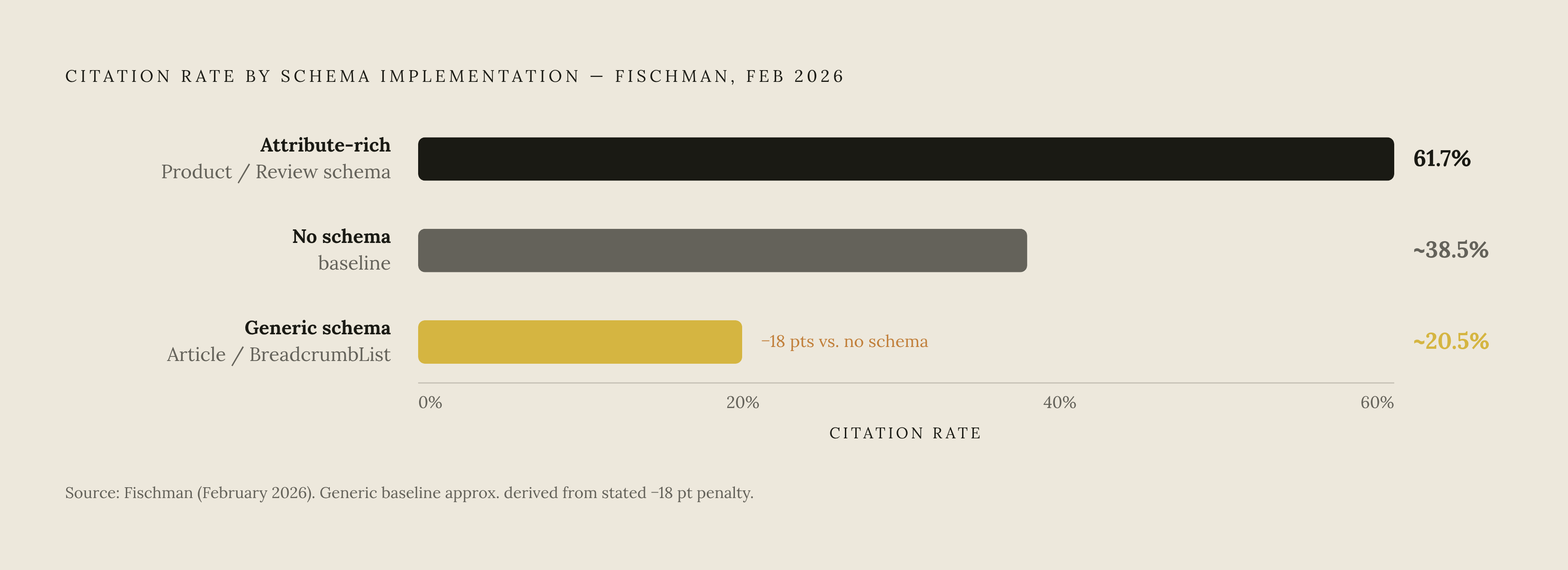
None of this means schema is worthless. It means the version of schema that helps is narrower than most advice admits, and it is defined by depth of content rather than presence of markup. Fischman's data shows Product or Review schema populated with concrete, verifiable attributes, pricing, aggregateRating, specifications, availability, achieved a 61.7% citation rate, substantially outperforming generic schema types like Article, Organization, or BreadcrumbList at a statistically significant level (p =.012).
Schema that encodes facts an engine can verify behaves differently from schema that only labels a content type: one gives the system something to check against other sources; the other just tells it what kind of page it is looking at. And the gap cuts both ways. Generic schema carrying only the required fields produced an 18-percentage-point citation penalty compared to pages with no schema at all: a shallow implementation performed worse than doing nothing.
The same principle carries over directly to author entities, even though the schema type is different. A Person node with populated knowsAbout values, sameAs links, and real credential fields is attribute-rich in exactly the sense that drove the Product and Review results. A Person node with only a name and a job title is generic, and the evidence suggests it carries no meaningful advantage over having no author schema at all. The lesson from Product schema transfers to Person schema almost without modification: depth of verifiable detail is the variable that matters.
One area remains genuinely unresolved. Sophisticated entity-linking, Wikidata sameAs links, true @id cross-referencing between a publisher's entities and external authoritative records, appeared on fewer than four percent of schema-present pages in Fischman's sample, too rare to evaluate statistically. Whether that kind of deep entity-linking produces gains beyond what basic attribute richness already captures is a question the current evidence simply cannot answer yet.
How named authorship affects citation probability across different engines
Authorship itself, independent of the schema wrapped around it, carries a measurable citation effect, and it is larger than anything schema alone has been shown to produce. Named-expert quotations produce a 28% citation lift compared to generic team attributions. A byline reading "written by the team" is effectively invisible to these systems in a way a named founder or subject-matter expert with a real biography is not.
Where that effort should go first depends on platform. ChatGPT averages roughly 8 citations per response and tends to favor named bylines over anonymous ones. Perplexity's Sonar pipeline runs live retrieval on every query and averages nearly four times as many citations per response as ChatGPT, a higher volume of sourcing built on a different weighting of what counts as a usable source. LinkedIn presence compounds this unevenly across platforms: Semrush measured LinkedIn accounting for a substantially higher share of citations on Google AI Mode and ChatGPT than on Perplexity, so a professional author with a strong LinkedIn footprint gets a measurable, platform-specific boost precisely on the two platforms where named authorship already matters most. For a publisher deciding where to build an author entity first, that points toward ChatGPT and Google AI Mode as the platforms where the LinkedIn and named-bylines combination pays off most directly.
The byline functions as the first trust signal an engine processes when corroborating E-E-A-T: a named expert, a credible publisher, and claims that line up with other authoritative sources on the same topic. Anonymous content offers none of these anchors to check against. The stakes are highest in YMYL content, where a page authored by a named, verifiable expert earns a higher citation probability than one credited to an "admin" account, a difference that is close to non-negotiable in health and finance publishing. Research out of Princeton and Georgia Tech on generative engine optimization reinforces the same point from a different angle: adding named expert quotations improved AI citation rates, alongside inline citations to primary sources and specific statistics, all of which point toward the content itself, rather than its JSON-LD wrapper, as the more actionable lever.
Organic rank is the prerequisite that schema and authorship optimize within
All of this sits downstream of a harder constraint: AI citation behavior is substantially mediated by the search ranking that happens before any AI-level evaluation of content even begins. Schema and authorship work only on pages that have already cleared that bar. Ahrefs found that 97% of AI Overview citations come from pages already ranking in the organic top 20. Search ranking is the prerequisite that schema and authorship work operates within.
Among top-ranking pages, only a minority actually get cited, and named authorship and attribute-rich structured data separate the cited pages from the uncited ones at similar rank positions. Google's own documentation on AI features states that both AI Overviews and AI Mode require nothing more than that a page be indexed and eligible to appear with a snippet in normal Search results. Meeting that baseline does not guarantee inclusion. Google has separately confirmed that no special schema is required for AI Overview eligibility and has never confirmed schema.org markup as a ranking factor for AI Overviews; its own structured-data documentation describes schema as an aid to understanding and display, not a ranking input.
Structure, distinct from schema, is a real independent lever. A March 2026 study introducing the GEO-SFE framework held the semantic content of pages constant and varied only their structural formatting, document architecture, information chunking, visual emphasis, and found a consistent improvement in citation rate and subjective quality across six generative engines. That result reinforces rather than contradicts the argument built so far: how content is organized on the page affects citation independent of markup, while the markup itself amplifies authority a page has already earned rather than manufacturing authority it hasn't. Named authorship and attribute-rich schema are necessary conditions for standing out among cited pages, but the ranking work that gets a page into contention comes first.
What changed in 2026 to make prior advice misleading
Two structural changes to Google's schema surfaces in 2026 have rendered a meaningful share of GEO advice written before mid-2026 wrong in ways that can actively misdirect implementation work.
Google retired FAQ rich results entirely on May 7, 2026. Any guidance still treating FAQPage schema as a way to win a rich-result snippet is describing a surface that no longer exists in general search. That does not make FAQ-style content worthless. Content structured as genuine questions paired with genuine answers remains useful for AI extraction even with the display snippet gone; the content format and the schema's old display surface have come apart from each other, and advice that still treats them as one thing is simply out of date.
A handful of lower-usage schema types went through similar simplification. Practice Problem lost both Search Console reporting and rich-result support in January 2026. Dataset was clarified to have always been exclusive to Dataset Search and never supported in general Google Search, part of a broader tidying of Google's structured-data surface. Search Engine Roundtable's reporting adds a further point that cuts against a lot of standard schema advice: both ChatGPT and Perplexity read structured data as though it were ordinary page text, not as a privileged data layer.
Auditing an existing schema implementation in light of all this means asking a different question than most practitioners have been trained to ask. Auditing existing schema means checking, for a product, a review, or an author, whether what it encodes holds enough verifiable, concrete detail to give an AI system something to check against other sources. Presence was never the variable that mattered. Depth was.
Sources
- Does Schema Markup Predict AI Citation? A Cross-Platform Empirical Study of Structured Data and Generative Engine Optimization by Kurt Fischman :: SSRN
- How to Structure Blog Posts for AI Citation in 2026
- Schema markup for thought leadership, authorship, and AI citations
- We Tracked 1,885 Pages Adding Schema. AI Citations Barely Moved.