How Query Length Is Shifting Toward Conversational Phrasing
Users are asking search engines full questions instead of keyword fragments.

Query length is changing shape because the reason for compression has disappeared. For two decades, users typed strings like "best CRM small business" instead of describing what they actually needed, something closer to "what is the best CRM for a 50-person marketing agency that integrates with Salesforce." That compression was never a stylistic preference. It was an adaptation to a machine that matched text against indexed strings and had no way to process context, nuance, or constraint. Users learned, through years of trial and error, which fragments of a thought a search engine could actually use, and they discarded the rest.
Large language models removed the reason for that discipline. Once a system can parse context and intent rather than hunt for string proximity, the user no longer has to translate a situation into a query a machine can digest. The shift this produces is best understood through the same sentence typed a decade apart: in 2015, someone searching for software typed "best crm small business"; in 2026, that same person asks Gemini or ChatGPT "what is the best CRM for a small service business," carrying the identical intent but expressed in full, with the context that used to get stripped out before it ever reached the search box. Nothing about what the user wants has changed. What changed is the cost of saying it, and that cost dropped to nearly zero.
Google's redesign signals longer queries as the new default
Google rebuilt its search interface at Google I/O 2026, the first redesign of that scale in over 25 years, and the decision alone says more about where query behavior has gone than almost any survey could. The new search box expands dynamically to accommodate longer, conversational input, and it offers AI-powered suggestions in place of the autocomplete strings that trained a generation of searchers to think in fragments. A company does not rebuild an interface that has anchored its core product for a quarter century on a whim. It rebuilds that interface when the cost of not rebuilding it, measured in users drifting to platforms that already match how they want to ask questions, has become larger than the cost of change itself.
Google's own figures back this up. Data the company reported in May 2026 states that the average AI Mode search runs three times the length of a traditional search query, a comparison Google is making about its own product against its own historical baseline, with the market leader measuring the gap between what it used to receive and what it receives now.
A mechanical layer explains part of this: AI Mode's architecture reportedly fires multiple simultaneous sub-queries in response to a single user prompt, with one conversational question triggering a cascade of smaller, traditional-style lookups behind the scenes. The user types one long, natural question. The system breaks that question into the keyword-shaped fragments it still needs internally, runs them in parallel, and reassembles the results into a single answer. The compression work hasn't vanished. It has moved from the user's head to the system's infrastructure, which is exactly the inversion that explains why users no longer feel pressure to think in fragments.
What the query-length data shows across platforms
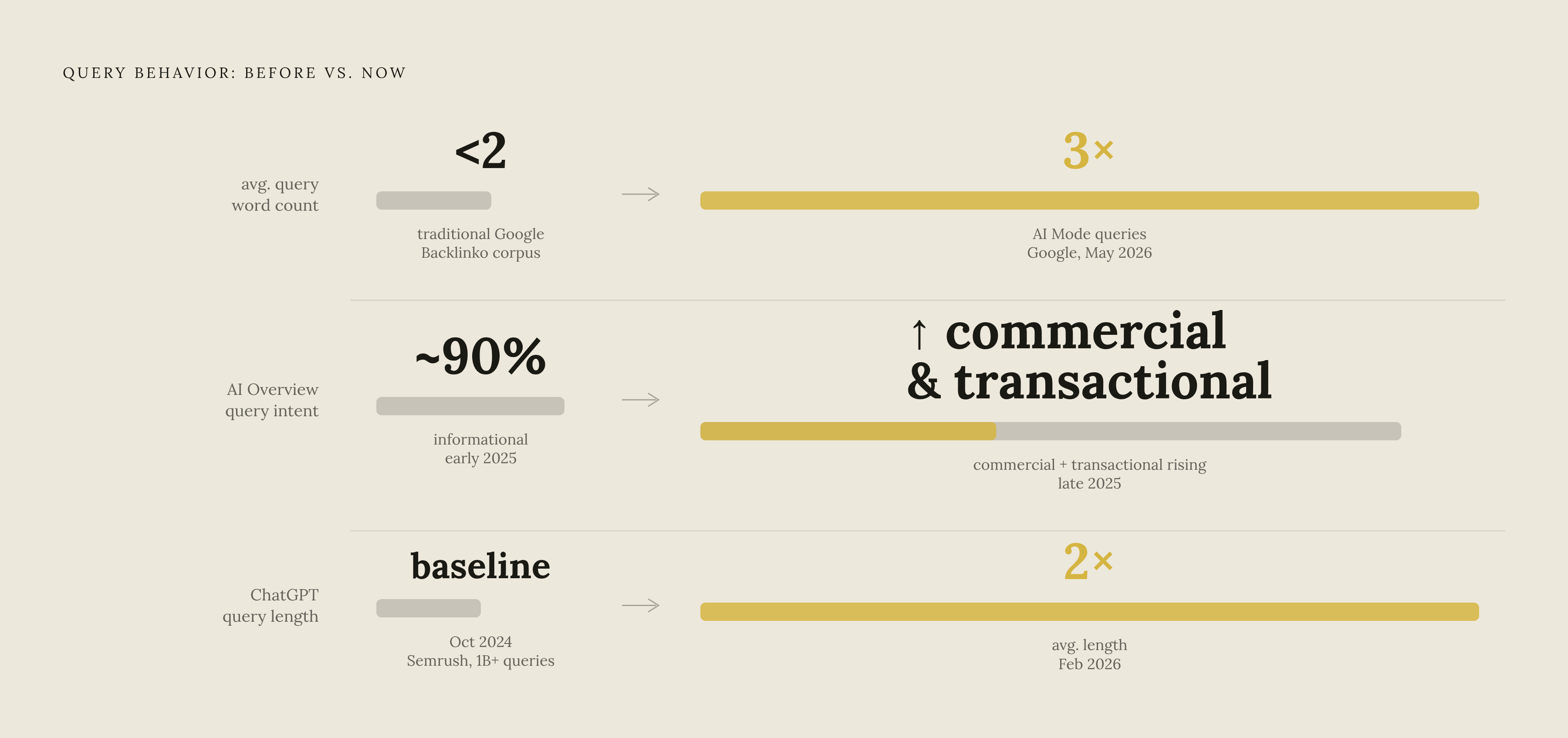
The pattern holds everywhere query length gets measured, and the magnitude of the gap between old and new search behavior is substantial. In traditional Google search, short queries have fallen sharply as a share of total impressions, while medium-length queries have taken over as the dominant segment, a shift that Google Ads impression data documents across the period from January 2025 onward. That is movement inside Google's own core product, independent of any AI-native competitor.
The shift looks even sharper on AI-native platforms. Semrush's analysis of more than one billion lines of US clickstream data, covering ChatGPT usage from October 2024 through February 2026, found that even search-enabled queries, the ones that trigger a live web lookup rather than relying purely on the model's training, nearly doubled in average length over that period. These are the queries closest in function to a traditional search, and they still grew dramatically longer.
Set against the old baseline, the scale of the shift becomes clear. Backlinko's analysis of a large corpus of US keywords found the average keyword runs under two words. That number is the ruler against which the Semrush figures and the Google Ads data should be read: a world built around two-word strings is colliding with a world of paragraph-length prompts and sub-queries three times the old average. Voice search sits at the far edge of this same curve. Users speak full questions into voice assistants rather than typing fragments, and the average voice query runs dramatically longer than its typed counterpart, a gap that reflects the same underlying mechanism: speech was never compressed the way typed search was, because there was no keystroke cost to discourage full sentences.
Why keyword research tools miss most AI prompts
The shift in query length is not simply quantitative. The shape of the query has changed in a way that most measurement infrastructure cannot see. A tool with that much coverage failing to match most of what users are actually asking means the thing being typed no longer resembles a keyword.
These unmatched prompts are not edge cases or rare, idiosyncratic phrasing; they represent the majority of AI search demand, and they take the form of full situational briefs, bundling context, constraints, budget, and prior attempts into a single message. A services buyer typing into ChatGPT at length might describe their business, their current backlog, their available budget, and what they've already tried that didn't work, all in one prompt, where the page built to serve that buyer was optimized for a keyword running two to four words.
The mismatch is structural, a mismatch built into the tools themselves. Keyword research platforms were built to index the queries that passed through Google's traditional interface, an interface that compressed intent by design because that was the only format the underlying system could process. Those tools did exactly the job they were built to do. The query shape changed underneath them, and no amount of expanding a keyword database will recover visibility into prompts that were never keyword-shaped to begin with.
Conversational phrasing's migration from research into purchase intent
Conversational phrasing began as a research behavior, the shape of queries people typed while learning about a topic before they were ready to buy anything. The intent data shows that pattern dissolving. In early 2025, the overwhelming majority of AI Overview queries were informational in nature. By late 2025, that share had dropped substantially, while commercial and transactional intent rose dramatically over the same window. Conversational phrasing is not confined to people doing background reading anymore. It has become the shape of the queries people type at the moment they are deciding what to buy.
Google's own AI Mode data reinforces the direction of that movement. Planning-related queries grew faster than AI Mode queries overall, and brainstorming queries also outpaced the overall growth rate since launch. Both of those intent categories sit immediately upstream of a purchase decision. The conversational query is showing up earlier in the funnel than informational content strategies have typically assumed.
Transactional queries still click somewhat differently than informational ones, and that distinction matters for how traffic eventually converts. But the directional finding stands regardless of that nuance: a content strategy that treats conversational optimization as relevant only to top-of-funnel, informational pages is already behind, because the query shape that demands a full situational answer, budget and constraints included, is now appearing at the exact moment a buyer is deciding what to purchase.
AI-generated answers and the traffic longer queries used to deliver
The same infrastructure encouraging users to type longer, fuller questions is also the infrastructure intercepting the clicks those questions used to generate. Academic research by Saharsh Agarwal and Ananya Sen found a substantial decrease in outbound organic clicks when AI-generated summaries are displayed alongside search results. The study's more important finding is where those losses concentrate: informational queries bear the brunt of the decline, a result that contradicts the idea that AI summaries are only eliminating visits nobody wanted.
That pattern has a clear logic to it. Short, factual queries, the ones a model can answer completely within the summary itself, see the steepest declines in click-through, because there is nothing left for the user to go find. Queries that require a decision, a comparison between specific options, or a commitment of money or time are affected far less, because no AI summary can make that decision for the user. AI-generated answers now appear across a substantial share of all search queries, a share that has grown significantly from where it started, so the coverage of this interception is widening even as its actual effect on clicks stays uneven across query types.
That unevenness is the filter: whether a page still earns traffic depends on more than query length. What determines it is whether the query requires something an AI system cannot fully resolve inside its own summary: a commitment, a side-by-side comparison of named options, a decision carrying real stakes. The pages worth building now are the ones built for exactly those queries, the ones AI answers least completely, instead of the ones built for queries AI already closes out on its own.
The ranking model's shift from position to citation
Every mechanism described above points toward the same structural consequence: the competitive objective in search is moving from ranking for a position in a results list to being the source an AI system chooses to cite. The old model rewarded a page for targeting a keyword, building content around it, and capturing a click when a user selected that result from a list of ten. That model assumed a list existed for the user to scan.
Under the AI Mode model, there is no list to scan. Google synthesizes a single answer directly, and a page either gets cited as a source inside that answer or it does not appear in the conversation at all, with no equivalent of a second page to fall back on. Conversational search optimization, as a discipline, describes the task this creates: answer the whole question a person asks, because engines retrieve the content that most cleanly resolves the entire query, not the page that repeated a target phrase the most times. The content that wins under this model matches the full situational shape of the prompt that generated it, addressing the budget, the context, and the prior attempts a paragraph-length query bundles together, rather than optimizing for keyword density against a two-to-four word phrase.
Google's "Information Agents," announced at I/O 2026, push this further still. These agents operate continuously in the background, scanning content for changes relevant to a user's configured topic or prompt, rather than evaluating a page once at the moment a query is typed. A single, well-optimized snapshot in time is no longer enough when the system monitoring that content is tracking it continuously for change. The question to ask about any page, going forward, is no longer which keyword it was built to rank for. It is which full situation, budget, constraints, and prior context included, that page is built to resolve completely.