Information Trust Signals Users Apply to AI-Generated Answers
Users trust AI answers based on surface cues they rarely verify.
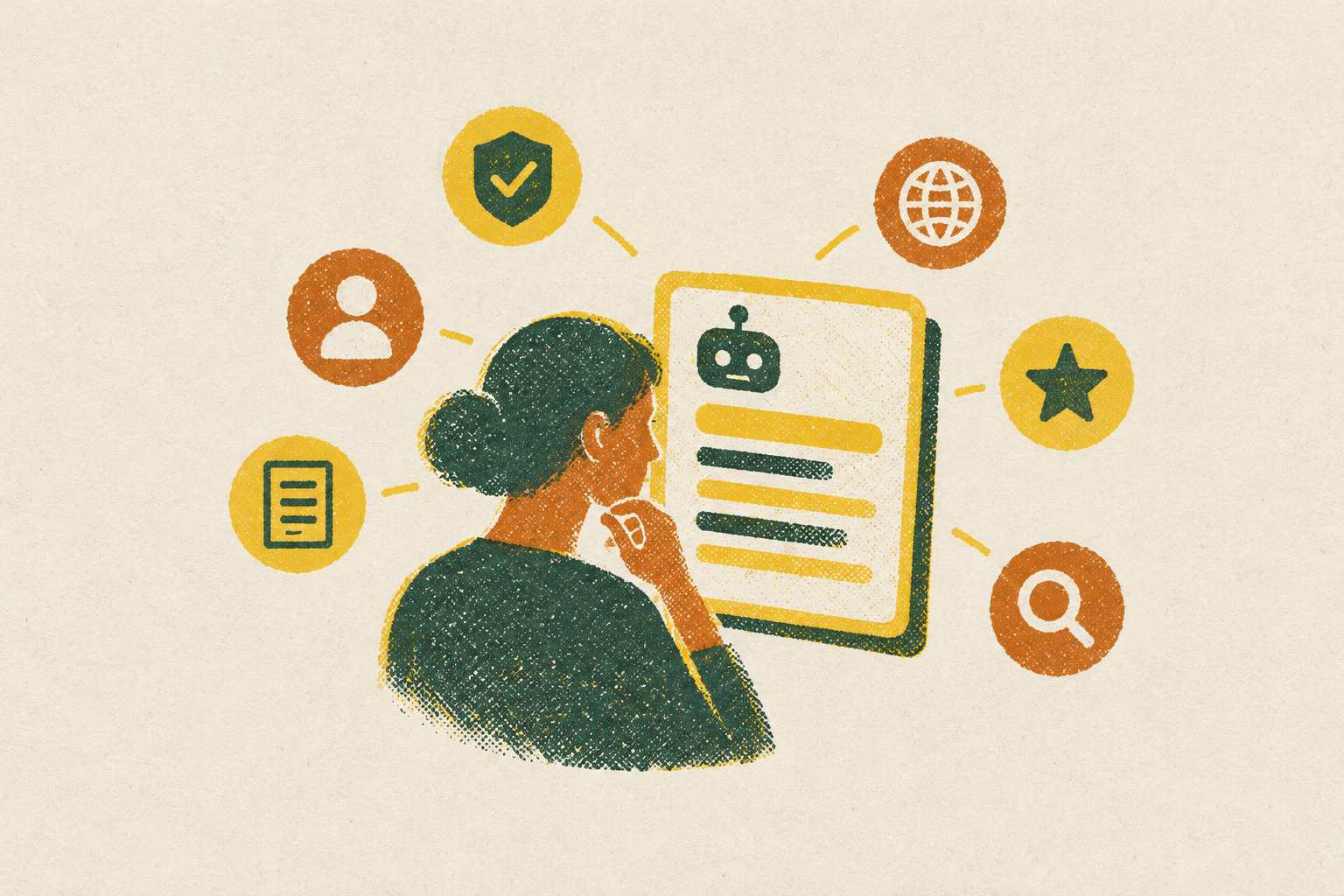
Trust in AI-generated answers rests on a hierarchy of signals, from clear presentation and visible citations to source validity, domain expertise and institutional oversight. This hierarchy explains why trust is widespread but brittle. The easiest signals to recognise encourage acceptance, while the signals that can justify that acceptance often require verification that users do not perform.
How generative search changed the credibility problem users face
Casermeiro-Corpas et al. (2026) describe a change in how people look for information, from comparing ranked documents to judging synthesised answers. A ranked list lets users judge what to believe by comparing what each source says, where it comes from and whether the sources agree. Generative search instead gives users one answer built from information they may not check. The synthesis becomes the object of evaluation. Its apparent coherence can replace the comparison that previously helped users decide what to believe.
The Reuters Institute’s 2025 report found that information seeking had surpassed media creation as the primary use of AI. It also found that weekly use had nearly doubled, making answer credibility a routine concern. The change is therefore not simply another way to display search results. It changes where evaluation begins and how much evidence is immediately available. Users still judge credibility, but they now do so with a narrower and less reliable set of tools.
The baseline state: widespread use alongside provisional, fragile trust
The Reuters Institute report found that trust stood at 50% among people who encountered AI answers. YouGov’s July 2025 survey similarly found that two-thirds of AI users trusted AI to some degree, although most did so cautiously and only a small fraction trusted it completely. Use does not require complete belief in the answer. Users can value a system enough to consult it while remaining uncertain about what it produces.
That uncertainty coexists with the practical benefits that bring users back. The Reuters Institute report identified speed and information aggregation as reasons for initial trust without verification of accuracy. YouGov found much higher trust among avid users, those who use AI at least three times a week, than among those who use it only now and then. Familiarity appears to function as a signal in its own right, without establishing that answers are more accurate. Yet accuracy was still the top concern among avid users, who worried about it slightly more than users overall did. Familiarity creates a working confidence that each subsequent answer can reinforce or disrupt.
Surface-level cues: how clarity, visual presentation, and response style drive first impressions
The Casermeiro-Corpas study found that clarity and context had the strongest association with trust among the cues it measured. Access to sources ranked below them, while response immediacy was not significant. The study’s structural equation model explained 75.7% of the variance in trust, although that figure describes the model as a whole. This distinction keeps the finding in proportion. Clear explanation is associated with credibility, but the result does not establish that a clear answer is a correct one.
The same research’s eye-tracking study found that generative answers attracted the most attention, while error warnings received no measurable fixations. Users looked at the prominent answer rather than the caveat. This helps explain why users judge how an answer looks and reads before they check closely what it says. The interface makes some information more noticeable than other information, irrespective of whether users consciously treat layout as evidence.
Presentation is therefore part of credibility assessment. A well-organised answer gives users something they can understand and use, while confident wording supplies a readily recognisable signal of certainty. Neither signal requires an inspection of the underlying sources. That makes both available at the earliest stage of an encounter, when users are deciding whether the answer deserves further attention.
Citations as a credibility shortcut that works independently of accuracy
The experiment reported in arXiv:2605.10930 found that citations increased trust in AI-generated answers even when the citations were invalid. Trust fell only when participants checked the links. This separates the effect of displaying evidence from the effect of examining it. A citation can raise confidence without supporting the claim.
The Casermeiro-Corpas study supports that distinction from a different direction. Access to additional information and supporting sources had the second-strongest association with trust, and interview participants treated visible references as authority cues without routinely verifying them. The reference signalled that support was available.
Citations provide a route from an answer to its evidence, and the experimental finding shows that users who take that route can revise their trust. But research on LLM citation behaviour has found invalid citations and hallucination rates that differ widely from one model to another. The shortcut is especially consequential because it resembles a deeper check while requiring only the recognition of a familiar format. Users who inspect sources can calibrate their judgment more closely, but their behaviour does not remove the vulnerability in encounters where references remain unopened.
How stakes and domain modify the trust signals users choose to apply
A recipe and a choice of cardiologist invite different levels of scrutiny. The contrast makes the stakes gradient clear. An answer that is sufficient for a low-cost everyday choice may be only a starting point for a decision with medical, financial or legal consequences. Trust in AI therefore depends on what a person stands to lose if this particular answer is wrong.
The Reuters Institute report found that many users checked AI answers about health and politics against non-AI sources. Yext’s Consumer Search Behaviors Report 2026 likewise found that most consumers looked for sources they felt had more authority when making high-stakes decisions. Users look beyond the answer to signals that can support a decision, rather than merely make the response plausible. The same person can apply a light evaluation framework in one domain and a more demanding one in another.
The Yext report found that reviews were the most trusted signal when consumers verified information. Yext’s Search Archetypes Survey 2025 found that nearly half of consumers checked an AI answer against other information, and contradictions such as wrong hours, outdated information or reviews that disagreed could break their trust. The answer’s presentation gives way to agreement with information found elsewhere, exposing how conditional the initial confidence was.
The verify-but-insufficiently gap: why declared caution outpaces actual checking behavior
Higher stakes can increase the intention to verify without reliably producing verification. The Reuters Institute report found that roughly a quarter of users rarely or never clicked through to source links. A displayed source and an inspected source are different events. The first can increase perceived reliability even when the second never happens, leaving the answer accepted on a weaker basis than the interface appears to offer.
The gap is not evidence that users lack all discrimination. A 2025 qualitative study of 192 participants found that hallucinations prompted context-sensitive trust recalibration. Users adjusted their expectations according to the domain and the circumstances of the error. That is more nuanced than treating every answer as equally dependable or equally suspect. It nevertheless leaves room for under-verification, because a more careful attitude does not itself establish whether a particular claim is supported.
A warning nearly doubled task performance when AI gave faulty support, but participants still did no better than those who had no AI help. Similarly, rising declarations of verification describe a developing norm. The unresolved problem lies between recognising that verification is appropriate and doing enough of it to test the answer. That gap lets provisional trust last until users spot an error in some other way.
Institutional and systemic signals: oversight, brand, and commercial contamination
The KPMG/University of Melbourne global study of 48,000+ respondents found that four in five people would be more willing to trust an AI system with assurance mechanisms in place. Those mechanisms included reliability monitoring, human oversight and independent third-party assurance. These governance signals address whether the system is subject to controls that users cannot infer from a polished answer alone. Institutional reputation therefore gives surface cues a broader context in which to be judged.
Professional grounding can also distinguish one system from another. Users place more domain trust in domain-specific tools with specialist training than in general models, even when the general model has better benchmark scores. Conversely, 2026 research on AI disclosure found lower trust in an answer labelled AI-generated than in an equivalent answer without that attribution, with stronger AI-related cues associated with lower perceived authenticity.
Ipsos research found that people across many countries would trust AI answers less if advertisers influenced them. This is an emerging trust variable. As platforms consider advertising as a revenue model, perceived commercial influence introduces a concern distinct from factual accuracy. A response could be clear and well referenced while still leaving users uncertain about why it was selected or presented. Citation formatting cannot resolve that institutional question, because supporting a claim and explaining the interests behind an answer are different tests.
Why the hierarchy of trust signals produces trust that is both widespread and brittle
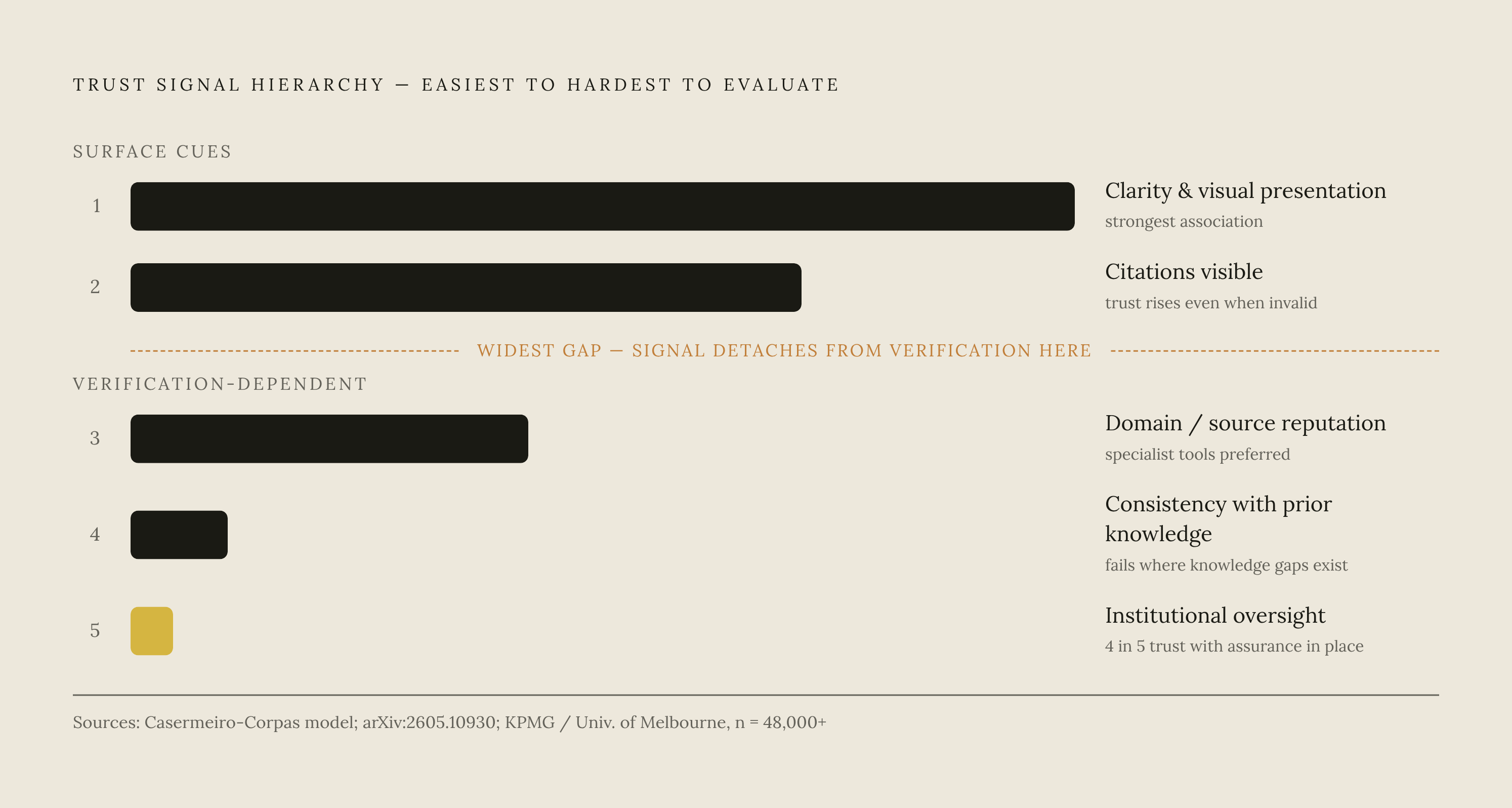
Signals that encourage initial acceptance are visible and easy to process, while signals that can challenge acceptance often require leaving the answer and inspecting other information. For low-stakes queries, that arrangement can be sufficient for the decision at hand. Higher stakes change the required standard, but not necessarily the behaviour. The same polished response can receive initial trust even when the deeper evidence needed to justify reliance remains unexamined.
Citations occupy the hinge between these two levels. They appear to connect the answer to external authority, yet function as surface cues until someone follows and evaluates them. Consistency with prior knowledge supplies another backstop, because users can reject claims that contradict what they already know. But that protection is uneven too. Where users have little prior knowledge, fewer contradictions are available to interrupt acceptance, even when the domain demands accuracy.
The Yext consumer report shows why trust and verification are not opposites. Consumers who trust AI still verify, and inconsistencies found during that process can overturn confidence in the original answer. For publishers, brands and information professionals, appearing in an AI answer is a first step. Those checks depend on information in reviews, official sources and direct website data that is correct and agrees across sources. Yext’s approach to structured, authoritative data feeds addresses this need at the information-source level. Trust can be earned or lost at several points in the hierarchy, but the verification layer is where initial confidence is most often confirmed or withdrawn.
Sources
- Generative AI and news report 2025: How people think about AI’s role in journalism and society
- Most Americans use AI for quick answers, but avid users trust it more
- Evaluating the False Trust Engendered by LLM Explanations
- From search results to generative answers: A mixed-methods study of credibility assessment and trust formation in AI Overviews - ScienceDirect
- Trust, attitudes and use of artificial intelligence A global study 2025