Perplexity Answer Engine Citation Mechanics
How retrieval, reranking, and search depth shape which sources become citations.
Perplexity’s citation mechanics explain both the value of its answers and the limits of their apparent proof. Each numbered reference is the visible end of retrieval, reranking, page reading, and generation. Citations are starting points for verification.
What Perplexity actually is: an answer engine built on live retrieval, not stored knowledge
Perplexity’s answer engine uses retrieval-augmented generation, or RAG. At inference time, a query triggers a live web search, and retrieved documents enter the language model’s context. The model then writes its answer from that material rather than relying on its training weights as the source of the response. This makes the retrieved context the immediate foundation of the answer. What the search pipeline supplies therefore matters as much as the model’s ability to explain it.
That architecture also determines how citation behavior should be understood. A reference reflects material surfaced by the pipeline. The consumer answer engine and developer API use the same RAG pipeline, though they have different interfaces and features. The central question on either surface is which sources reach the model and how the answer represents them.
Stage one of the pipeline: how Perplexity retrieves its candidate sources
Retrieval assembles the candidate pool through three methods running in parallel. BM25 keyword matching uses a classical term-frequency approach. Dense retrieval uses Perplexity’s proprietary pplx-embed, available in two parameter sizes and built on Qwen3 architecture. Hybrid retrieval combines keyword and dense signals. These methods gather candidates before the system ranks them and starts full-page reading.
The resulting pool contains roughly 60 sources per query, far more than will appear as citations in the final answer. A page can be in this pool and never reach the language model. The distinction matters because finding a relevant page does not mean the system will use or acknowledge it.
The search mode changes the scope of this first stage. Standard search retrieves and analyzes a smaller source set, while Pro Search reads substantially more sources and prioritizes academic and research-grade content. Sonar Deep Research runs an agentic multi-step loop across an even larger set. These differences change what the later stages have to work with, but a larger pool alone does not establish citation accuracy.
Stage two: the reranker that decides which sources survive to become citations
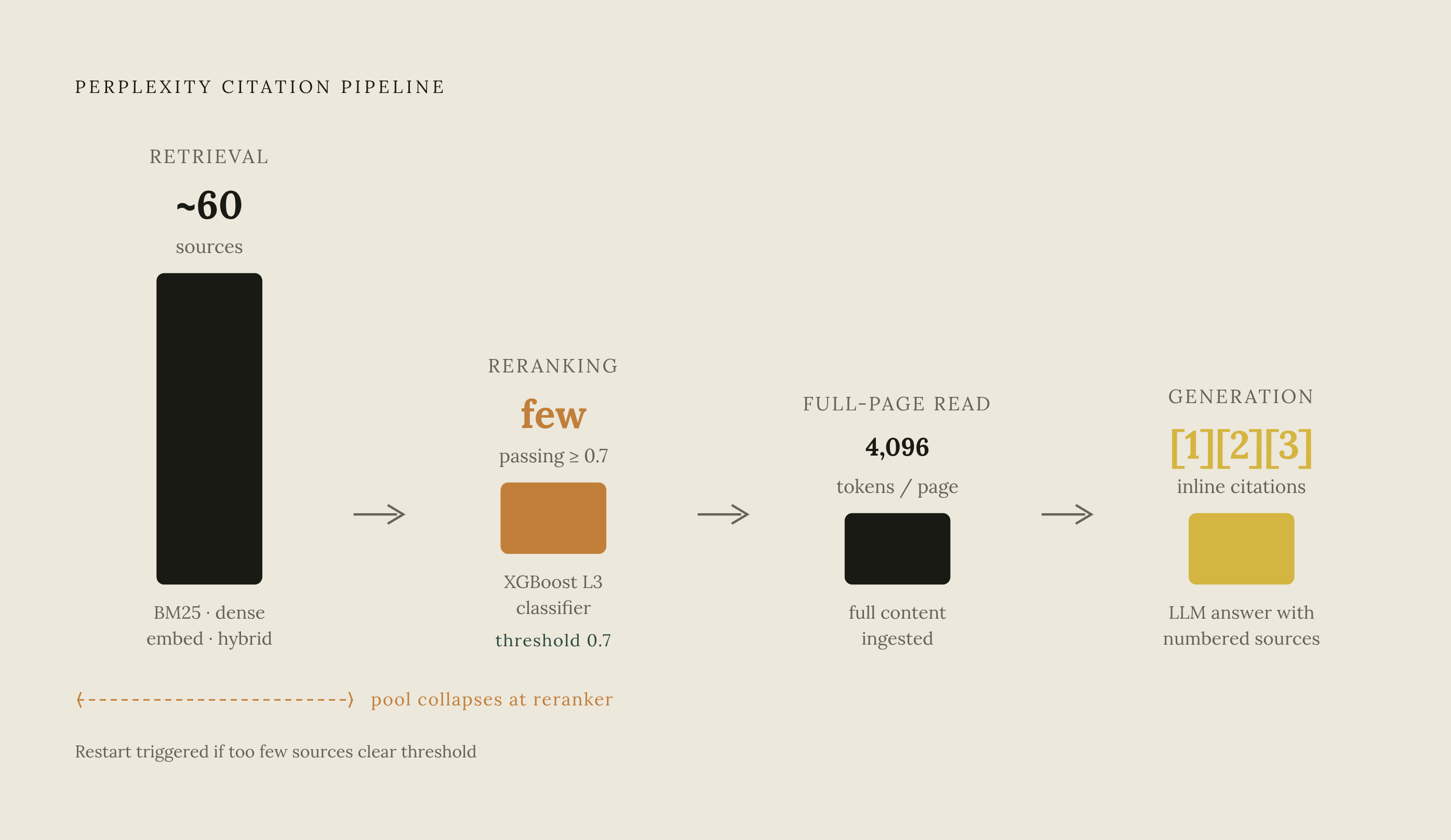
The reranker is the decision gate between candidate retrieval and answer generation. A multi-layer ML classifier, rather than the language model, determines which candidates clear the quality threshold. It runs three layers, with XGBoost at the final layer, L3. The reported threshold is approximately 0.7, leaving only a fraction of the roughly 60 candidates.
If too few sources clear that threshold, the entire result set is discarded and retrieval restarts. This favors quality over coverage, but it can also exclude valid sources that rank lower. Relevance is not the only signal in that decision. Freshness and source diversity also affect which material survives, so the selection already has a particular character before the answer is written.
Research on Perplexity’s Sonar found that it visited roughly ten relevant pages for each query but cited only three or four. This is the attribution gap, in which a source can influence an answer without receiving a numbered reference. For anyone auditing provenance, the citation list is therefore narrower than the set of material that may have shaped the response.
Stage three: full-page reading and how the language model attaches numbered citations
After reranking, Perplexity’s URL-fetching tool reads page content. The default is 4,096 tokens per page, giving the model substantially more source material than a snippet-based system would provide. Full-page reading gives the model access to the page body, with a limit on how much it can read from each page. The language model then writes a coherent answer and generates numbered citations inline. Those numbers are intended to connect claims to their sources, rather than being appended after the answer is complete.
The model determines how deeply this process runs. In the 2026 Sonar family, standard Sonar uses a single pass without a reasoning layer, while Sonar Pro cites many more sources. Sonar Reasoning Pro, the current consumer flagship, replaced Sonar Reasoning on 2025-12-15 and can run real-time search with multi-step reasoning. Sonar Deep Research extends the process into an agentic multi-step research loop.
R1-1776 is a separate case because it provides offline reasoning without live web search. Fetching source text and attaching a reference are parts of answer production.
What the pipeline is systematically biased toward: freshness, Reddit, and passage-level relevance over authority
Freshness, source diversity, and direct answerability all help determine which sources survive. A source that answers the immediate question clearly can therefore have an advantage over a more authoritative page that addresses it less directly.
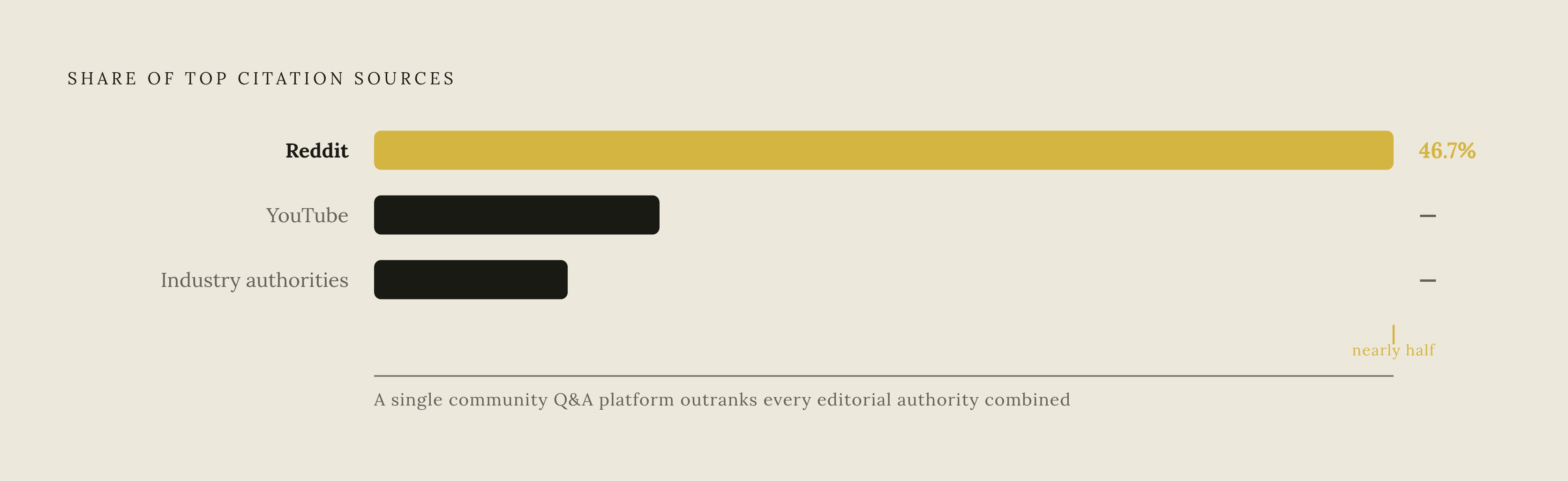
Reddit accounts for 46.7% of top citation sources. It ranks so high because its topic-specific communities have direct question-and-answer content, which gives it an edge regardless of its authority. YouTube and industry authorities such as Gartner follow at significantly lower shares. The same preference for specificity explains why a page at position 12 on Google can still earn a Perplexity citation.
That preference also creates an opening for adversarially optimized content. Mochizuki et al.’s work on citation vulnerabilities found that sources with low content-injection barriers are frequently cited yet tend to be poorly reflected in answers. Such sources allow content to be published without specialist authority. Material which is easy to publish can enter the citation pool and influence the output without being faithfully represented.
The three ways citations mislead even when the pipeline works as designed
The numbered format makes an answer look verifiable, but it does not establish that the cited evidence supports it. Three distinct failures can sit behind the same reference marker. A hallucinated URL points to a page that never existed. Following the link can expose that failure, although most users do not do so. Its visibility makes it simpler to detect than a reference that opens successfully but proves nothing.
The harder failure is a real URL attached to an unsupported claim. The destination exists, yet its contents do not justify what the answer says. To spot this, the reader must check what the source says as well as whether the link works. The answer can still go beyond what the source supports even when the model has full-page access.
Citation index drift in the API creates a third failure, in which footnote numbers point to the wrong source because citation tokens were assigned incorrectly during generation. A separate, compounding risk arises when the source itself contains a hallucination. Perplexity can cite a live AI-generated page containing fabricated statistics and pass those statistics into an answer with the appearance of support. The retrieval pipeline evaluates relevance and freshness.
How Perplexity's citation accuracy compares to the field, and what that comparison actually means
Independent benchmarking places Perplexity at the top of the field for citation accuracy. That lead matters, but the error rate is still roughly one in three. These findings answer different questions. Ranking first shows how it does against other tools, while the error rate shows how much checking the reader still has to do. Neither finding cancels the other.
The Columbia / Tow Center study found a higher error rate for the Pro variant in particular. In that comparison, the higher-tier mode did not close the reliability gap. More extensive retrieval and reading should therefore not be treated as substitutes for citation accuracy. The mechanisms can expand the evidence available to an answer without making its references more dependable.
The practical weight of that distinction depends on how the answer will be used. Roughly one in three wrong has different consequences for casual curiosity and for research entering a client deck. In the latter case, a reference can carry an unsupported claim into work that others rely on. Perplexity can lead the field and still leave readers with a lot to check. Its benchmark position and that burden are both part of an accurate assessment.
The legal challenges now threatening to reshape which sources the pipeline can retrieve
A legal constraint layer is forming around the technical pipeline. Copyright and trademark litigation asks not only how Perplexity handles source material, but which material it is permitted to retrieve and surface. The New York Times filed its complaint on December 5, 2025, alleging large-scale scraping, including paywalled articles, through a private index used by the RAG system. These are allegations, not findings. Their architectural relevance is that they concern the source access on which retrieval depends.
Other suits involve News Corp and Dow Jones, the New York Post, the Chicago Tribune, Encyclopedia Britannica, Merriam-Webster, Reddit, and Japan’s Yomiuri Shimbun. CNN’s May 2026 complaint is described as the seventh major publisher lawsuit in under two years. The disputes create uncertainty around the permissible candidate pool. A change in access could affect the material available to every later stage. How the courts will rule is still open.
Media companies are making agreements with AI firms that exchange access to verified archives for compensation, attribution, and links. The New York Times struck a multi-year licensing deal with Amazon while pursuing separate litigation, showing that commercial agreements and legal conflict can coexist. In January 2026, Perplexity signed a three-year, $750 million agreement with Microsoft to use Azure cloud and the Foundry service, gaining access to models from OpenAI, Anthropic, and xAI. How licensing terms develop could expand or constrain the retrieval surface, but the partnership alone does not settle those boundaries.
How to use Perplexity citations without being misled by them
The pipeline explains where verification effort belongs. On fast-moving topics, treat citations as starting points because freshness can push newer, lower-authority material ahead of older, stronger sources. For any claim entering a client deck, published article, or press release, open the cited page and confirm that it supports the specific statement. A working URL shows only that the page exists. Reading for support addresses the more consequential gap between a real source and an unsupported claim.
The source’s own reliability also matters. If the cited page is AI-generated, its fabricated content can pass through retrieval without being detected, leaving the verification chain broken at the source. Research depth does not remove this risk. Sonar Deep Research generates a higher hallucination rate than standard Sonar despite its greater depth, so tier choice should reflect both query complexity and the verification effort the user is willing to apply.
For sensitive research, the attribution gap means that an absent citation does not establish an absent influence. Publishers can address a different part of the process through schema markup with author credentials, visible year signals in titles and headings, and content that answers questions directly. These measures support both citation rates and the accuracy of attribution. They help the pipeline select and represent content, but do not turn selection into proof. The proper role of a Perplexity citation remains a route to evidence that the reader must assess.