Purchase Decision Journeys That Now Start in AI Interfaces
Brands must now compete for visibility inside AI tools, not just search results.

Purchase decision journeys now start in AI interfaces, but they do not necessarily end there. AI dominates discovery, research, and evaluation, while search and brand sites still complete many transactions. For marketers, the strategic task is to distinguish where a purchase decision forms from where it becomes visible, then build for both.
How the purchase funnel still exists — but AI now owns most of it
The purchase funnel has been restructured while its five stages remain intact as cognitive tasks, namely discovery, research, evaluation, decision, and purchase. What changed is the channel infrastructure that supports those tasks. Buyers can now move through several stages inside an assistant, where brands once had repeated chances to appear in search results or get visits to their sites.
Similarweb’s 2026 AI Brand Visibility Index found that roughly one in three US consumers begins product discovery in an AI tool, a share that outnumbers those starting in Google by more than two to one. The same index shows that consumers prefer AI at every funnel stage except the last. Absence from an AI-generated answer can exclude a brand from consideration before a buyer opens a search bar, even if that brand remains easy to find through search. Marketers therefore need a stage-level map of influence alongside a comparison of traffic from AI and traditional channels.
Discovery — the stage where AI’s takeover is most complete
Discovery is where AI compresses the most browsing work. Instead of presenting a ranked set of links for consumers to investigate, an assistant delivers a synthesized response that can already contain a shortlist. A brand is either mentioned in that response or absent from it, making inclusion a more immediate dividing line than position within a search results page. Consumers can leave the exchange with options in mind without having visited any of the brands considered.
The same pattern extends into B2B buying, where vendor shortlists frequently form inside private chatbot sessions before a seller knows the account exists. G2’s Tim Sanders describes the shift as buyers moving “from reference to inference.” The distinction is between consulting material and receiving a conclusion drawn from it. As an illustration, a buyer can shortlist three vendors in a chatbot, visit one site, and book a demo. Only one seller receives that visit, although the assistant has already framed the choice among several vendors.
This compresses the opportunity to enter the consideration set. A strong search ranking can help when buyers consult search, but it cannot guarantee exposure when discovery happens elsewhere. The relevant contest begins with the options an assistant presents.
Research and evaluation — the middle of the funnel where AI’s influence is underestimated
Consumers also use it to compare specific brands, weigh trade-offs, and narrow shortlists, taking questions into assistants that marketing models traditionally assigned to product pages, advertising, and reviews. Similarweb’s data places AI ahead in consumer preference at comparison and evaluation as well as discovery. The assistant is therefore not merely supplying names at the entrance to the funnel. It is helping buyers decide which names survive.
That work can stretch across tools and days. Buyers may ask one assistant for a category recommendation, another to compare two brands, and a third to surface quality concerns. In B2B, several members of a buying committee may do their own private research at the same time. The resulting evaluation is distributed even when the eventual purchase appears to follow a simple path. AI and search are complementary in this pattern, because a buyer can use an assistant to resolve trade-offs and search to investigate or act on the resulting choice.
The influence can also run against a sale. Among consumers who use chatbots while shopping, a large share report abandoning a planned purchase after the chatbot advised against it. An assistant can both suppress existing intent and generate new consideration. That makes evaluation a consequential stage in its own right, rather than a holding area between discovery and conversion.
Why last-click attribution makes AI’s influence invisible to most marketing teams
Last-click attribution assigns credit where the visible journey ends. AI is rarely that last stop, even when its answer shaped the buyer’s choice. A consumer can discover a brand through an assistant, conduct a branded search or type the URL directly, and then purchase. Analytics records the arrival as organic or direct traffic. The transaction is observable, but its origin is not.
Private chatbot research deepens this familiar dark-funnel problem. Third-party intent data platforms that track the web content people read cannot see the research they do inside an assistant. A vendor may therefore encounter a buyer only after important comparisons have already happened, with no record of which alternatives appeared or which concerns shaped the shortlist. For a buying committee, the seller may be missing this context from several people’s separate research. A clear downstream conversion does not make the upstream decision process clear.
This can steer budgets toward the channels closest to the purchase. Brand and content investments that support AI visibility can look inefficient under last-click models, while branded paid search captures credit for buyers who have already decided. Click-through rates and referral traffic therefore show only part of what AI does to help. Brand mention frequency in AI-generated answers addresses a different question, which is whether a brand appears where choices form. Most brands lack the infrastructure to track that exposure, leaving a gap between measurable arrivals and unobserved influence.
The final stage — where search still closes the transaction and why that matters for strategy
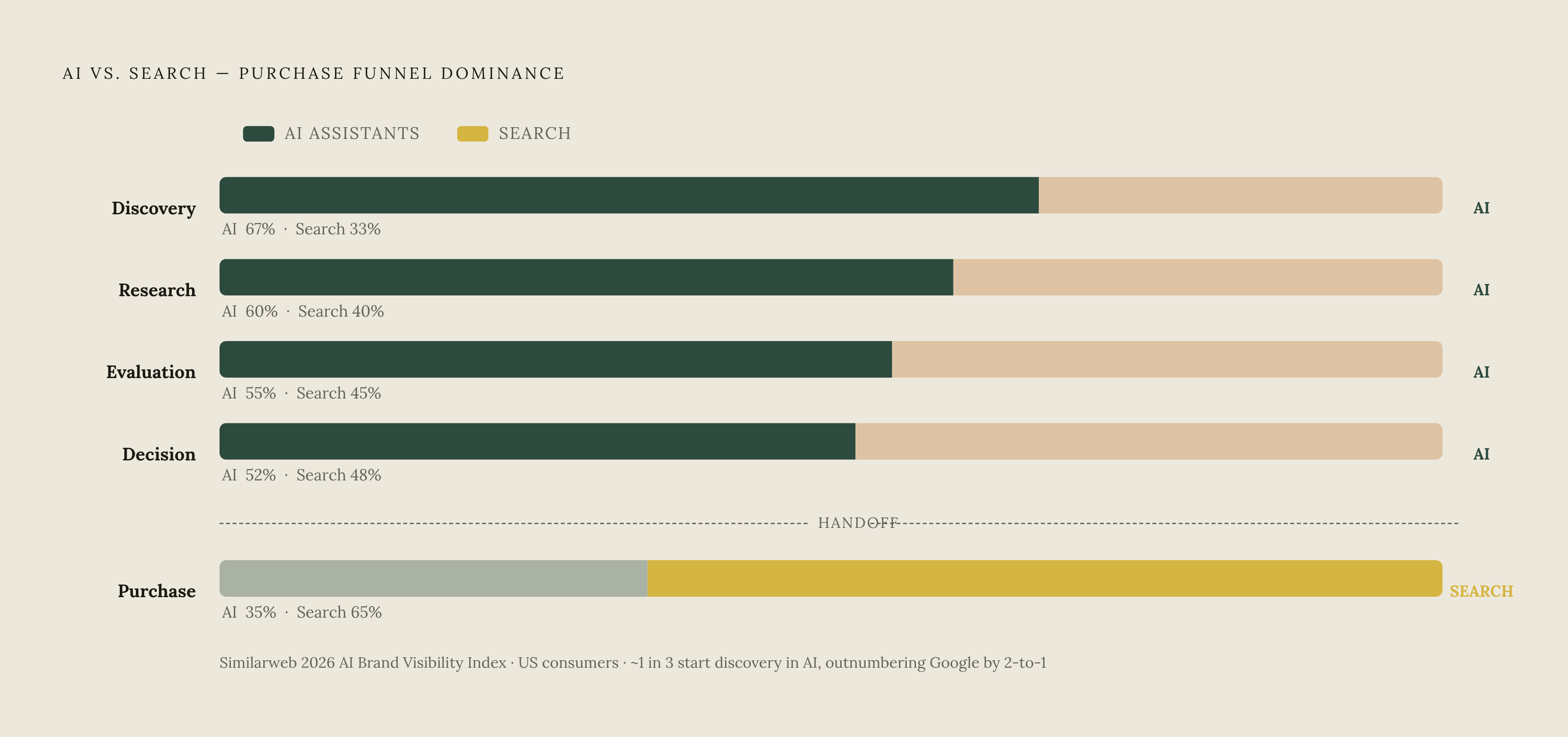
Search closes on AI’s shortlist. Buyers still use it to navigate to specific sites, confirm prices, and check availability before completing a purchase. Similarweb’s index identifies this final stage as the point where search reasserts itself as the tool consumers find most useful. The handoff is important because a recommendation and a completed transaction are different tasks. AI can establish a preference without providing everything needed to act on it.
For brands, the strategic implication is a change in SEO’s continuing role. Search remains valuable for helping buyers complete decisions that an assistant has already shaped, even as it loses some of its earlier role in winning consideration. AI-referred traffic to transactional sites also converts at higher rates than many traditional channels. That is consistent with visitors arriving after substantial evaluation. Direct AI referrals reveal part of this value, but they do not capture journeys completed through a later search.
Buyer expectations are moving beyond the current handoff. Shoppers increasingly expect to ask a question in a conversation and make a purchase there, but brands have yet to catch up with what shoppers expect. Search’s present strength at the final stage is therefore not evidence that the channel division has reached a stable endpoint. It describes the current arrangement before assistants take on more of the transaction.
Agentic commerce — the next restructuring already beginning
Agentic commerce changes who acts on the recommendation. In the current pattern, a human generally takes the assistant’s advice and completes the next step. An agent can instead make and complete purchase decisions on the buyer’s behalf. That extends AI’s role from shaping intent to executing it, removing the human handoff that currently gives search and brand sites much of their final-stage value.
Shopify has built Agentic Storefronts to connect store product catalogs directly to AI shopping assistants. Through its partnerships, brands on the platform are set up to sell within AI channels including ChatGPT, Microsoft Copilot, Google AI Mode, and Gemini. The structural change is more important than the connection itself. A catalog becomes available within the environment acting for the buyer, rather than depending entirely on a consumer navigating to a storefront.
Google VP Carrie Tharp described AI as evolving “from a passive tool that offers prediction, to active, autonomous resources that can execute complex, multi-step, prescriptive actions across every consumer and operational touchpoint.” A consumer whose agent places an order need not visit the product detail page, read the brand story, or see an ad. The purchase can proceed without the consideration-phase brand encounter through which a company would otherwise explain its product and shape the buyer’s judgment.
Trust as the load-bearing condition for AI-mediated commerce
Paid placement threatens the condition that makes AI recommendations commercially valuable. Buyers rely on assistants as purchasing advisers because they regard the guidance as useful and sufficiently neutral. If recommendations appear to reflect purchased influence rather than the buyer’s needs, that confidence can weaken. Poor recommendations create a similar risk through disappointing outcomes. Trust is therefore a market constraint on AI-mediated commerce.
The incentives for brands are uneven as a result. Brands that earn visibility benefit when an assistant’s recommendation produces strong purchase intent. Attempts to buy influence, however, risk undermining the confidence that gives the recommendation its value. Buyers can keep trusting the same interface as an adviser only if they accept its reasons for favoring particular products. Its commercial influence depends on that acceptance.
Trust also differs according to the task delegated. Millennials and Gen Z already place more trust in AI product guidance than in human retail associates, while confidence in AI handling payment information remains much lower. That gap can slow agentic commerce even as the infrastructure becomes available. Brands face a separate exposure because AI characterizations can affect buying behavior regardless of the actual product experience. Those characterizations develop in sessions brands cannot directly observe or correct in real time, making visibility inseparable from how accurately the assistant represents the product.
Generative Engine Optimization — what brands can do to be visible where decisions are forming
Generative Engine Optimization, or GEO, addresses the content and measurement requirements of appearing in AI-generated answers. It is an emerging discipline. Shopify’s 2026 ecommerce trends report identifies LLM optimization as part of AI’s further influence on ecommerce, including a founder’s prediction of a shift from search engine optimization toward LLM optimization. The practical distinction is between optimizing for a search result and making a brand discoverable within an assistant’s response. How well a brand does in traditional search alone cannot show whether buyers can find it in an assistant’s response.
For practitioners, the first requirement is measurement suited to the objective. Similarweb’s GEO guide distinguishes SEO measures such as organic clicks and rank position from GEO measures including brand mention share and sentiment distribution. Mention frequency helps show whether a brand appears in the answer, while sentiment shows how the answer describes it. A team needs that infrastructure to adequately evaluate its GEO investment and distinguish progress from assumption, especially when later branded searches conceal the original source of consideration.
The next requirement extends beyond conversational visibility to agentic access. Products need structured, machine-readable information to be discoverable by purchasing agents, making catalog presentation a prerequisite for participating in that layer of commerce. For a brand, the relevant strategic distinction is between being presented as an option and making products accessible to an agent acting on that option. These are related requirements, but success in one does not establish success in the other.
First-party data provides the practical complement to those efforts. Otherwise private research can be visible in demo requests, sales call content, specific questions on calls, and new stakeholders on email threads. Tracking those signals still leaves a need for GEO measurement, because what buyers do later cannot show everything that happened inside an AI session. It does give brands evidence from the part of the journey they can observe. Connecting that evidence with AI visibility work provides a firmer basis for decisions than treating the final click as the whole purchase journey.